German Awards - Hindenburg-Beverungsabzeichen
This badge of honor was awarded in the fall (September) of 1921 by a retired major commander. donated by Valdov. The latter commanded the self-defense battalion of Field Marshal von Hindenburg. (This should not be confused with the Freischar of Hindenburg of the Upper Silesian city of Hindenburg.) Upon his return to Hanover, von Waldow founded the military association "Verband Hindenburg," which lasted until 1927, and then entered the Tannenbergbund. As chairman, he then instituted a probation badge for the former Freikorps of Field Marshal von Hindenburg. It was awarded to honored former members of the Free Corps. In May 1921, von Waldow formed the volunteer corps of Field Marshal von Hindenburg in Lower Saxony. It included volunteers from the cities of Braunschweig, Hanover, Clausthal and members of the Lower Saxony Steel Helmet Union. The volunteer corps was involved in the 3rd Polish uprising to guard the section from Reinersdorf to Simmenau. The initial strength was 35 officers and about 560 soldiers. Later they became almost 1000 people. In June, Hindenburg's detachment as the 2nd Battalion was attached to the Nollau Self-Defense Regiment. After several bloody battles for Zembowitz and Pruskau, the voting area had to be cleared. The volunteer corps was disbanded at the end of June 1921. Parts remained in Upper Silesia, others returned to Lower Saxony. The exact number of awards is unknown. The awards continued after 1927, probably by traditional clubs. Badges with a wide needle and a thin needle are known. In 1934, the sign was banned by the Reichswehr and the Ministry of the Interior.
High oval, openwork sign made of silver-plated non-ferrous metal. The central letter is enameled in front. At the back is a vertical pin with a mating hook.
Front side:
- The edge is formed from an oak leafy wreath tied with a double loop.
- The latter flows from above into a 7-toothed crown (baronial crown) with ball tips.
- The wreath consists of 5 groups of leaves on the left and right with 3 leaves and fruits.
In the - center is a large black enameled silver burgundy letter - H -.
- It is between the lower wreath and the crown.
Downside:
- Smooth and silver. Vertically - a pin with a reciprocal hook.
.
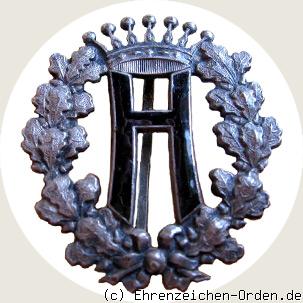 Front: Hindenburg probation badge
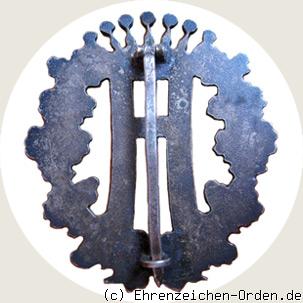 Reverse: Hindenburg Sign
Established:
September 1921, retired major. von Waldow
Data:
- Material: non-ferrous silver-plated metal, enamel
- Size: 48mm x 43mm
- Weight: about 17g
estimated collector price:
260 – 280 €

 Awards of World War II