German Awards - Silesian Mark 2nd Class
The Silesian Parole Badge, also referred to simply as the Silesian Eagle, was awarded by Commander General VI. Army Corps, Lieutenant General von Friedeburg, Commander-in-Chief of Army High Command South, General v. d. Borne and Chief of Staff Major Hesterberg, presented on June 16, 1918. They were awarded to all fighters who participated in the defense of the Silesian homeland in 1918 and 1919. The design of the badge of honor was developed by the Breslavl sculptor Professor Theodor von Gozen. This award consisted of 2 classes. 2nd class for 3 months of service and 1st class for 6 months of service in this unit. With a few exceptions, 2nd class can also be awarded to civilians if they have earned protection and have resided in Silesia. 1st class was not awarded to civilians. The badge of honor had to be paid by the loanee himself. The award was to end on February 1, 1920. But with the 3rd Polish Uprising of 1921, the awarding was resumed by the self-defense of Upper Silesia. In 1921, this award was presented by a retired lieutenant general. Hoefer expands around swords and oak leaves. Thus, a total of 8 different options were created: 2nd class, 2nd class with oak leaves, 2nd class with swords, 2nd class with swords and oak leaves, 1st class with oak leaves, 1st class with swords, 1st class with swords and oak leaves. In 1933, the Silesian Eagle was recognized as a state award and can be worn in the Federal Republic of Germany. Source: Ingo G. Harke, Awards of the German Volunteer and Volunteer Forces 1918-1921. and their successor organizations, 2019.
A sign of blackened iron in the form of a standing eagle, head to the right. On top is one soldered eye with a ribbon ring. The back side is smooth.
Front side:
- On the chest is a silver-plated crescent, in the center of which is a cross.
- The legs rest on a curved, silver-plated ribbon with the inscription: - ZA - SILESIA -
Downside:
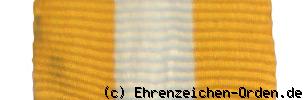
Tape:
- Width 25 mm, 3 stripes yellow/white/yellow 8 mm each.
Photos of www.Militaria-Berlin.de
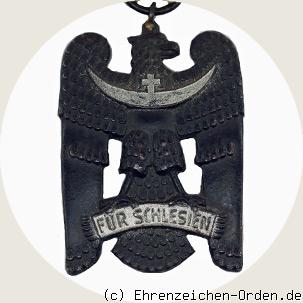 Front: Silesian Mark 2nd Class
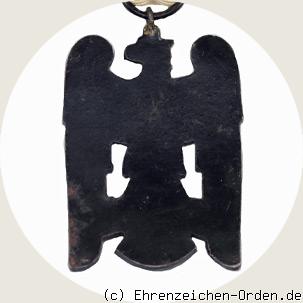 Reverse: Silesian Mark 2nd Class
Established:
June 16, 1919 General Command VI. Army Corps
Data:
- Material: iron blackened
- Size: 31.5mm x 46.7mm
- Weight:
estimated collector price:
80 - 90 € in iron

 Awards of World War II