German Awards - Freikorps Oberland Probation Mark
The parole mark was established as part of the creation of the Oberland Union on October 25, 1921. The symbol of the freikorps and badge was the edelweiss, as well as a blue background for Bavaria. Veterans of the volunteer corps who took part in the hostilities were involved. But it is also proven that members of the Oberland Union, the successor organization to Freikorpus who participated in the Hitler coup on November 9, 1923, also received a parole mark. The project was prepared by prof. Dr. Karl Dibich (1899-1985), co-founder and artistic director of the Allah Porcelain Manufactory, as well as adviser to H. Himmler on artistic issues.
Freikorpus Oberland was created at the request of Rudolf von Sebottendorf. Permission was obtained in 19.04.1919 by the government of Bavaria in exile. The corps was formed by Major Ritter von Beckh in Trehtlingen and Eichstätt. The volunteer corps was formed from members of the "Thule Fighting Alliance" and volunteers from the Oberland area around Miesbach and initially numbered about 350 people. To suppress the Soviet Republic in Munich, the Volunteer Corps was included in the White Army. It consisted of units of the Reichswehr and other free corps of Württemberg, Hesse and Prussia. The number of the "white army" was about 35 thousand people. After the defeat, the Volunteer Corps still remained in Munich and was subordinate to the 21st Reichswehr Infantry Brigade. On April 8, 1920, a volunteer corps of 420 people was sent to the Ruhr region to fight the Red Army, but no longer participated in major battles. On April 30, 1920, the Oberland Volunteer Corps was disbanded. Members of the freikorps rallied to the "Escherich organization" and practically continued to exist. Thus, the Volunteer Corps was able to intervene very quickly in the 3rd Polish uprising. Already on May 12, 1921, the Oberlanders put up 3 battalions of about 1000 people. During the assault on Annaberg in Upper Silesia, they created the largest compound and substantiated the myth of the freikorps. After the partition of Silesia, parts of the Freikor remained in Silesia and were probably involved in Femian killings and retaliation. The Freikor fighters who returned home joined the Oberland League, created on October 25, 1921. Long-term chairman Dr. Friedrich Weber (veterinarian) was instrumental in having members of the former Freikorps take an active part with 2,000 men in the Hitler coup and march on Feldherrenhall on 9 November 1923. If you base the participating freikor fighters, 2000 to 3000 conventional signs should have been issued. The manufacturers were Deschler & Sohn in Munich as well as Pöllath in Schrobenhausen. There are gold-plated and silver-plated badges.
Enameled diamond icon. On the back is a horizontal pin soldered with plates. The manufacturer speaks eloquently about this.
Front side:
- Gold-plated border badge. The background of the inner side is enameled blue.
In the - center is an image of the golden board of Edelweiss. In the center there are 3 large and one small yellow dot .
- They are surrounded by 8 irregularly located white petals.
- Petal without vein.
Downside:
- Smooth and silver plated. In the center is a soldered pin.
- Above it is a sublimely knocked out manufacturer - DESHLER -/- MUNICH -/- - - 9 - -.
- The number of the holder or holder is often cut under the needle.
Photos of www.Team-Militaria.de
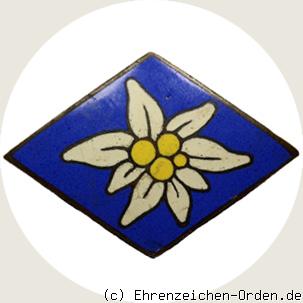 Front: Freikorps Oberland Symbol
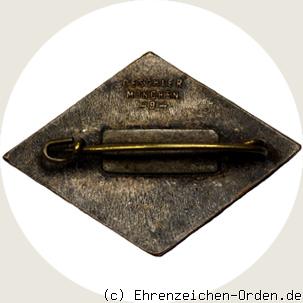 Reverse: Freikorpus Oberland Probation sign
Established:
October 25, 1921 Oberland Confederation
Data:
- Material: non-ferrous metal with gilding, enamel
- Size: 44.46mm x 30.94mm
- Weight: 10.87g
estimated collector price:
420 - 440 € in bronze with gilding
250 - 270 € silver plated in copper

 Awards of World War II