Awards of Germany - Commemorative sign upon joining Munich in 1919
A memorial for the invasion of Munich in 1919 was established by Freikor Oberland, probably in the early 1930s. A fund to mark the 10th anniversary of the invasion is also possible. Members of the Oberland Freikorps who participated in the invasion and struggle against the Soviet Republic in Munich in 1919 were awarded. Not much is known about award requirements or award numbers. The badge manufacturer is Gg. Lindner is famous in Munich. The crosses of the company are made of thin sheet and painted. A simple brochure has the name of the company and was applied using filled zinc or lead with a plate. The higher quality mark shown here is made of a silver-plated alloy with enameled inserts with a needle system. Badges in silver are also known. More valuable badges were probably later obtained by the wearers. Despite the attitude towards the National Socialist Movement and the respected Freikorp Oberland, the sign was already banned from wearing in 1934, and was finally banned in 1935. This concerned production, trade and wear. The three runes in the middle of the cross were also a sign of the Teutonic Order in Bavaria.
A straight, slightly domed cross made of silver-plated tombac or copper alloy. The crosses are slightly expanded outward. Through the center pass 2 crossed, stylized swords with blades down. The recessed inserts of the front side are enameled with black. Rear side with vertical needle with reciprocal sheet metal hooks.
Front side:
In the - center of the cross there are 3 runic signs from the Scandinavian runic alphabet.
- They mean - inherited possession - fertility - movable property -.
- Distributed on cross sleeves: above - FREIKORPS -, below - OBERLAND - left - MÜNCHEN -
huh - on the right - I.-MI.- 1919 -.
Downside:
- Slightly grainy and silver-plated.
- A pin is applied perpendicularly using plates.
- Sheet metal strip counterhook.
.
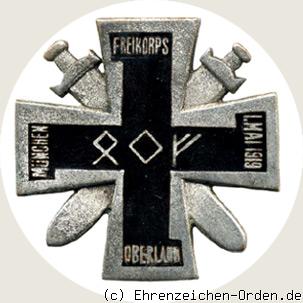 Memorial for the invasion of Munich in 1919
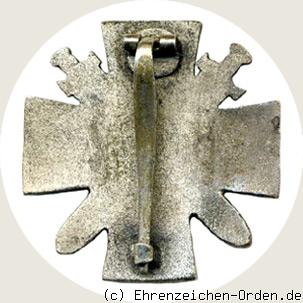 Reverse: A memorial for the 1919 invasion of Munich
Established:
circa 1929 Freikorpus Oberland
Data:
- Material: Tombak silver-plated, enamel
- Size: 43mm, swords 46mm
- Weight: about 17g
estimated collector price:
380 – 400 €

 Awards of World War II