Germany Awards - Freikorpus Lützow Parole Mark
The insignia of Freikor Lutzov was probably donated before the disbandment of Freikor by its commander, Major von Lutzov. A prerequisite for the award was membership in the Lyuttsov volunteer corps for at least 6 months. The award certificate is unknown. However, the award was entered in the military passport with the assignment of a number. The souvenir manufacturer is Godet from Berlin. For award items, the matrix number is knocked out on the crown. But there are also badges without a manufacturer's number and designation. Aberrant zinc badges or openwork badges are also known. Whether icons without a loan number are secondary or secondary must remain open. Relatively many insignia were issued. The icon shown here already has a matrix number 592. Lützow's volunteer corps was formed on 18 January by Major Hans von Lützow, Captain Erich von Bibow and Lieutenant Walter Den in Berlin. It was mainly equipped from the Luttsov infantry regiment of the 1st Rhine No. 25. Freikorpus in full force consisted of 75 officers, 244 non-commissioned officers and over 1000 people, mainly rangers. The unit included a battery of guns, a reconnaissance squad, an automobile squadron, sappers, as well as mine and flamethrowers. For the first time, the volunteer corps was involved in the March struggle in Berlin between March 3 and 16, 1919 against the rebellious workers during the general strike. Street fighting led to the deaths of more than 1,200 workers who ended the general strike on March 8. But the fighting ended only on March 16 after the cancellation of Noske's shooting order. After that, the Freikorpus in Braunschweig and Munich was involved in suppressing the dominance of the Soviets. On 1 December 1919, Freikorps became the 30th Jaeger Battalion of the Reichswehr in the Provisional Reichswehr. In 1920 he was transferred to the Ruhr region. In the battles in Remscheid against the Red Army, the troops suffered heavy losses, were partially captured by the Red Army or interned in the territory occupied by the British. After liberation in April 1920 it was disbanded. As another award, the honorary cross of Freikorps is also known, about which there is no additional information. There are no specific award numbers on the parole mark. Of the approximately 1,400 people, at least half should have been eligible.
High oval embossed brass badge. The edge and parts of the front side are gilded. The midfield is silver-plated. The reverse is smooth and gilded with a perpendicular pin with a mating hook.
Front side:
- The raised, gilded rim is formed from a laurel wreath.
- It ends at the bottom with a golden gardestra, and at the top with a golden crown with 7 balls.
- The midfield is silver-plated. Above under the crown is a gold, decorated letter - L -.
In the - center is a tall, plastically depicted hunting horn, which is superimposed on the right on the golden edge and protrudes slightly beyond it.
- Mouthpiece on the left. In the center, the horn is wrapped 4 times, on the left 2 times with 2 tubes hanging down.
- Various coniferous branches are in the background.
Downside:
- Smooth and gilded. Perpendicular - pin on a simple hinge and locknut.
- On the left at the edge of the manufacturers - GODET -, - BERLIN -.
- On the top of the head above the hinge, the matrix number is 592 -.
.
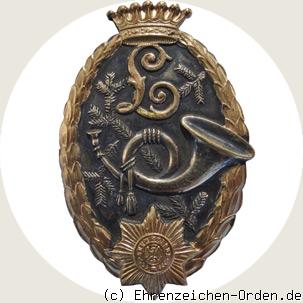 Front: Freikorps Lützow Legend
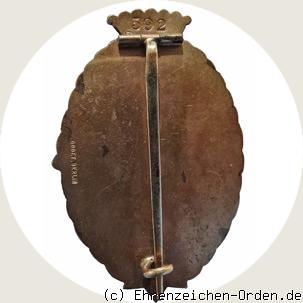 Reverse: Freikorps Lützow Probation mark
Established:
circa 1920 by Major von Lutzov
Data:
- Material: gold-plated/silver-plated brass
- Size: 64mm x 40mm
- Weight: 28.4g
estimated collector price:
400 – 450 €

 Awards of World War II