German Awards - Aulock Free Corps Badge of Honor
The badge of honor was established in 1919 by the former commander, Lieutenant Hubertus von Aulock.
The volunteer corps was formed on December 10, 1918 in Held near Hanover from the remnants of the Kit infantry regiment of the 1st Upper Silesian No. 22. In June 1919, the volunteer corps was transferred to the 8th Jaeger Battalion of the Reichswehr. On July 14, 1920, von Aulock was dismissed from service as a captain. The number of troops was about 320 people. Together with the Leuvenfeld Volunteer Corps, the Volunteer Corps participated in battles in Silesia at the 1st Polish Uprising. Supporting the Kappovsky putsch, the Aulok Freikorps occupied the city of Breslau and, together with other Freikorps, detained Faupel and the 3rd Marine Brigade of objectionable citizens. Later, the Wroclaw Regional Court brought charges of ill-treatment and torture. Von Aulock and 24 volunteers from his unit were charged. Max Walter, Wilhelm Biskup and Martin Breffka were sentenced at 14.3.1921 to long prison terms. In June 1921, the sentences under the "Kappov amnesty" were canceled. After the failure of the Kappovsky putsch, the volunteer corps of Aulok and others were transferred to the Ruhr region, where they fought against the Red Army. In 1921, the already disbanded Aulok Volunteer Corps was again involved in the 2nd Polish uprising in Silesia.
Hubertus von Aulock was reactivated in 3 Reich, and during World War 2 was appointed chief of staff of the commander of the forces of North-West France. September 2, 1944 was captured by the United States. The last rank is Major General Reserve.
High oval, openwork sign made of hollow broken non-ferrous metal. The front side is partially enameled. At the back is a vertical pin with a mating hook.
Front side:
- The edge is formed from a narrow oak-leaved wreath.
- At the top of the wreath is a smooth, rounded oblong shield.
- On it is an elevated date - 10.-12.-1918 - (creation of Freikorpus)
In the - lower third, the wreath is also covered with a smooth, rounded shield.
- It has a raised font: - FREIKORPS - (left) - VON - AULOCK - (right
). In - lower part just above the center is large, two-part, enameled letter - V -.
- This one is white below and enameled yellow-orange above. The lanes are separated by a line.
- Vertices V rest laterally on a wreath and from below on a shield.
A - plastically depicted deer trophy with a cross on the skull is superimposed on the letter.
- Bent horns have 5 ends on each side and protrude into the upper half.
Downside:
- Hollow embossed, negative face.
- Needle is passed sideways through hinged support.
- Counterhook on the bottom - V -.
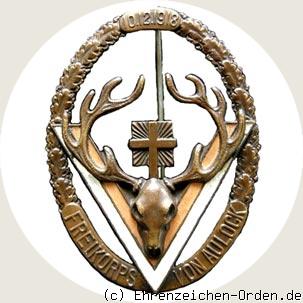 Obverse: Aulock Free Corps Badge of Honour
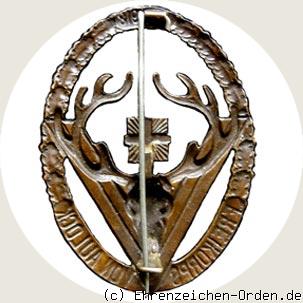 Reverse: Aulock Free Corps Badge of Honour
Established:
1919, Commandant Hubertus von Aulock
Data:
- Material: non-ferrous metal, enamel
- Size: 46.1mm x 61.4mm
Weight: 15.9g
estimated collector price:
380 – 420 €

 Awards of World War II