Germany Awards - Heydebreck Self-Defense Jäger Battalion Symbol
The jaeger unit's probation badge was probably donated after the final dissolution of the self-defense battalion in 1923 by former commander Captain Peter (Hans-Adam) von Heidebreck. I don't know anything about the award. However, with rarity, it can be assumed that few and honored colleagues and comrades were awarded, who during the World War were part of the jaeger corps.
Freikorps and especially its commander Heydebreck became famous for their participation in the 3rd Polish Uprising and the Battle of St. Annaberg on 21-27 May 1921. Von Heidebreck took over the leadership of the self-defense of Upper Silesia (SSOS) during the storm and was subsequently revered as the "hero of Annaberg." Members of the Free Corps bore the honorary name "Ver-Wölfe." The freikor song "Wild Daring Hunt" was written by Hamann (poet) and a member of the freikor.
In May 1921, in Lower Lusatia, adjutant Lieutenant von Witinghoff began the formation of the Free Corps. Old fighters of the free corps, comrades of former 6 rangers, students and volunteers from all over Germany were recruited. The first location was Gross Petervitz near Ratibor.
Another clash was the liberation on July 5, 1921 of the town of Kendzezhin, which later, on March 16, 1934, was renamed Heidebrek O.S. (until 1945). In July 1921, the Volunteer Corps was officially disbanded. Heidebrek's commander left Upper Silesia in the direction of Frankenstein County. The disguised volunteer corps was organized into so-called cleaning workers' organizations, but was still active in individual actions. Self-defense of Upper Silesia continued to work at the direction of government bodies. Heidebreck and his volunteer corps did not want to join this. Easter 1922 was arrested by Heidebreck in Kozel and was to be transferred to a prison in Opole. In the village of Prchivor, he was released by his volunteer corps and was hiding in Neustadt. After faking his death, he returned to the Volunteer Corps. According to an arrest warrant from Berlin, valid since the summer of 1922, in November 1922 he was hiding with the mother of Ensign Oswald in Gleiwitz. After the partition of Upper Silesia in 1922 in Geneva, his volunteer corps awaited a new deployment.
Freikorpus was divided into 3 detachments in the cities of Gleiwitz, Beiten and Hindenburg. In Hindenburg there were 5 companies led by Oberleutnant Beer, in Beuten - 5 companies under the Oberleutnant Kotzur (formerly Freikorpus Rossbach), and in Gleiwitz - 3 battalions led by Winterfeld. March 5, 1923 again arrested. In winter, Heidebreck was pardoned and expelled from the country. November 9, 1923 finally said goodbye to his volunteer corps.
Later he joined the NSDAP and in 1924 was a deputy of the Reichstag. In 1925 he founded the SA in Upper Silesia.
Since 1933 he was a deputy of the Reichstag and the head of the SA in Pomerania. As part of the Ryomsky coup, he was executed in 30.06.1934.
A hollow embossed sign made of silver-plated non-ferrous metal in the form of a deer trophy. Front side with enameled central part. Back side with perpendicular pin with mating hook. A small curved shield is attached to small chains under the badge.
Front side:
- The region is formed from a plastically depicted deer trophy.
- Below the skull, the side antlers are free, 3 on each side.
- The upper antlers, 3 on each side, merge at the top into a large imperial crown.
- Enclosed midfield underground with oval pattern.
- Centrally placed curved enameled shield with beveled upper corners.
- The shield is golden burgundy with a curved black cross on a white background.
In the - center is a large round medallion. The dotted background shines through with red enamel.
- She is wearing a white angel-like figure with a flowing robe. Below 2 crossed blades,
- on the chest is a book with crosses on the left and right.
- Lugs are provided on lower antler rods 2. A shield hangs on small chains.
- This curved with beveled corners below is pointed.
- It has a recessed curved 2-line font - JÄGER SCHAR -/- v.HEYDEBRECK -.
Downside:
- Hollow embossed, negative face. The shield behind is smooth.
- Back lined enameled shield with 2 horizontal rivets.
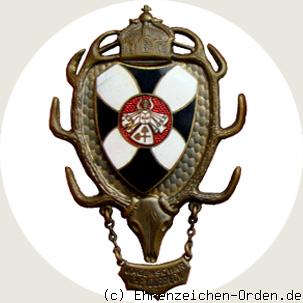 Front: Insignia of hedger self-defense battalion Heydebreck
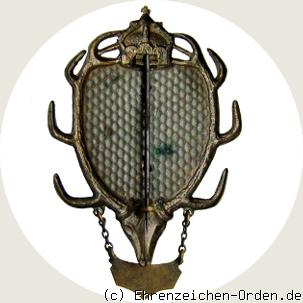 Downside: Heydebreck's Jägerschar Self-Defense Battalion Trial Mark
Established:
circa 1923 by commander Hans-Adam von Heidebreck
Data:
- Material: non-ferrous silver-plated metal, enamel
- Size: 61mm x 53mm, 39mm suspension
- Weight: 13.7g
estimated collector price:
600 – 700 €

 Awards of World War II