German Awards - 1918 Air Gunners Badge
This award was instituted on 27 January 1918 by the Kaiser and King William II. donated. The crew members met the following conditions. The servicemen had to demonstrate deep knowledge of engine building and its operation, flying, reading maps, air combat tactics, bombing, as well as machine gun maintenance skills on the ground, as well as air combat. Silver or silvered metal badges were made. They are either hollow embossed or hollow. In addition, semi-dimensional and embroidered structures with metal thread are known. The size can vary by several mm depending on the manufacturer and material. Openwork relief badges were also made. The badge could only be worn while the shooter was on active duty. After 3 years, he was able to obtain a commemorative airman badge, which seems unlikely after the end of the war, since the badge was only presented in 1918.
High oval embossing mark made of silver-plated metal. The back is a smooth lining with the manufacturer's designation. Eagle support is attached with 3 rivets. For fastening, a vertical pin with a mating hook is used.
Front side:
- The rim is formed from a wreath tied with a loop from below. On the right is oak foliage, on the left is laurel foliage.
- They connect with the upper imperial crown.
In - the closed field below behind the loop is a round shooting range.
- A hawk sitting on a shooting range, facing left, with wings spread up.
- The background is smooth. (Also with ray wreath)
Downside:
- Oval, smooth lining, 3 rivets.
- Vertical pin with mating hook.
- Sheet curved on cover - S.-E.- JUNKER - straight line underneath - BERLIN -.
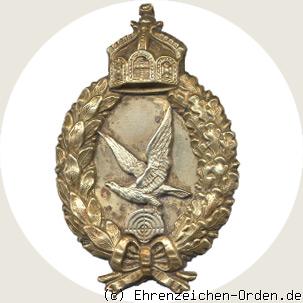 Front side: Sign of the pilot-shooter 1918
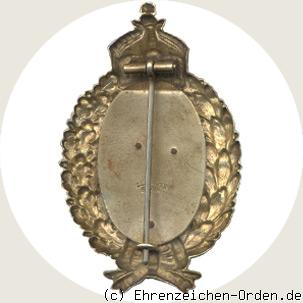 Reverse: 1918 Air Gunners Badge
Established:
January 27, 1918 by the king and emperor William II.
Data:
- Material: silver or non-ferrous metal, silver-plated
- Size: 65mm x 40mm
- Weight: 19g
estimated collector price:
1400 - 1500 € in silver
1000 - 1100 € silver plated in bronze
650 - 750 € silver plated in white metal

 Awards of World War II