German Awards - Wound Badge for 1918 Army and Colonial Troops in Black
This badge was established in recognition of servicemen who were injured in hostilities by the enemy or who became incapacitated as a result of injury. The badge was also adopted by the Bavarian king Ludwig III for the Bavarian army.
The wound sign was awarded in 3 stages. For 1-2 times, wounds were issued in black. Soldiers who were wounded 3 and 4 times received a badge in silver (also matte white). For 5 times and multiple wounds, the sign was awarded in gold. There are various options that differ in the shape of the helmet, the size of the loop and the length of the swords.
From January 30, 1936, higher degrees could be awarded with less frequent injuries, if this was justified by the severity of the injury or even injury.
The badge could also be worn on civilian clothing. In the trade of that time, silver versions were distributed in the form of a miniature or screw disk. The famous openwork performance was not awarded to officers and was not officially awarded. These comments were made in trade itself. Source: J. Nimmergut, Deutsche Orden und Ehrenzeichen before 1945, vol. IV, 2001.
Hollow embossed oval badge made of black iron sheet or non-ferrous metal. At the back is a vertical pin.
Front side:
Center - on 2 crossed swords German steel helmet, front left
- The oval is formed from a laurel wreath connected from below, a loop from below.
- The space between wreath, steel helmet and swords is numbered. In the openwork version, it is free.
Downside:
- Hollow embossed, vertical pin with clasp. Both flat and round needles are known.
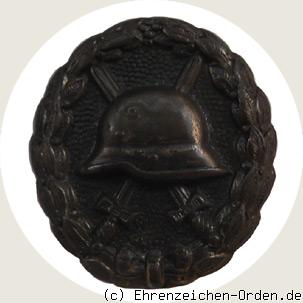 Front: Wound sign for 1918 army and colonial troops in black
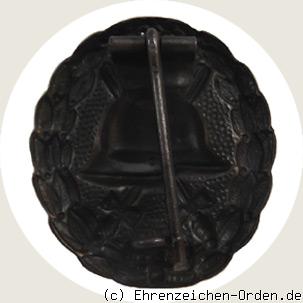 Reverse: Wound sign for 1918 army and colonial troops in black
Established:
March 3, 1918 by the king and emperor William II.
Data:
- Material: iron sheet/coloured metal sheet blackened
- Size: 45 x 39mm
- Weight: about 13g in iron, about 8g in non-ferrous metal
estimated collector price:
50 - 60 € blackened in iron
35 - 45 € in non-ferrous metal

 Awards of World War II