Awards of Germany - Memorial sign of the pilot 1914
The memorial sign was presented to the pilot on January 27, 1914 by the Kaiser and King William II. donated. Officers, non-commissioned officers and soldiers were to be awarded, which, in the event of mobilization, were no longer taken into account and were not intended for use. The badge was intended to replace the military aviation badge and the badge for observer officers. These badges were to be removed as soon as individuals ceased to be on lists for military aircraft commanders or surveillance officers. A prerequisite for obtaining a commemorative sign of the pilot was a preliminary, at least 3-year business trip and leadership in the lists. An exception was made for soldiers who were injured in the line of duty and lost their qualifications. Since 1916, layoffs began due to injury or accident. The decision to award was made by the chief of field aviation. After the war, former members of the Air Force could apply for a commemorative badge with the Air Force Inspectorate. A prerequisite should be 4 years of activity and parole before the enemy. The application was closed at the end of 1921. The badge was to be received after the established pattern and had to be paid for on its own. Through on-demand fabrication, variations in embossing image and size are known. In addition to badges in silver, options are known from silver-plated tin and silver-plated tombac. A famous manufacturer of silverware was C. E. Junker from Berlin.
High oval, openwork sign made of silver. The back is smooth, covered with a perpendicular pin with a response hook. Above the hook is the manufacturer's designation.
Front side:
- The edge is formed by a wreath connected from below by a loop .
- On the right is oak foliage, on the left is laurel foliage. They connect with the upper imperial crown.
- A closed field is punched in the upper part. The bottom is completely full.
The - lower part shows a plastic image of the landscape with mountains and buildings.
- This is analogous to the image in the military leader's sign.
In the - openwork part, a falcon flying to the left. The wings lie on a wreath.
- The tip of the tail touches the right wreath on the inside. The catches came together.
Downside:
- The back is smooth and recessed. Perpendicular to the pin.
- A loop in a sharply knocked out recess in the crown area.
- Counterhook down in the loop area. (Repaired with plate)
- Above the hook is captured the manufacturer - C.- E.- JUNCKER -/- BERLIN -.
- (Partly due to repairs)
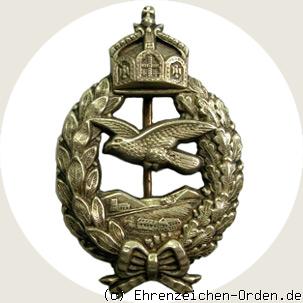 Obverse: Memorial sign of the pilot 1914
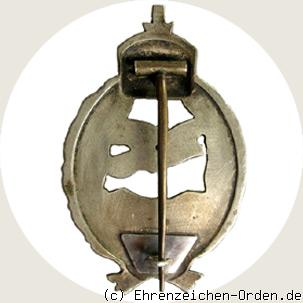 Reverse: Memorial sign of the pilot 1914
Established:
January 27, 1914 by King and Emperor William II.
Data:
- Material: Silver
- Size: 44mm x 72mm
- Weight: 31g
estimated collector price:
800 - 850 € silver
410 - 470 € silver plated

 Awards of World War II