German Awards - Commemorative Badge for Ground Forces Paratroopers
The commemorative sign was donated in 1920 by Defense Minister Otto Gessler. This was due to the upcoming disbandment of the air force. Already in 1916, it was proposed, but not implemented, the creation of a sign for army airships. The badge was awarded at will. Only the document was issued. The borrowed himself had to pay for the purchase of the badge. A prerequisite for the award was at least 1 year of work on an Army aircraft during the war. The period from the mobilization of August 1, 1914 to November 9, 1918. The Army used 47 airships until 1917. Officers, non-commissioned officers and soldiers who met this condition could apply for this badge, regardless of whether they were still on active duty or had already left. For soldiers who were wounded or captured while serving on airships, the minimum service life was 1 year. The design was made by the Berlin sculptor Professor Walter Schott. Silver and patinated white metal badges were also made. Paul Meibauer from Berlin is known as the manufacturer. For sea airship crews, a similar badge was donated at the same time as the sea airship and the imperial crown above the loop. It is estimated that the circulation will be less than 600 pieces. Source: J. Nimmergut, Deutsche Orden und Ehrenzeichen before 1945, vol. IV, 2001.
A recumbent oval badge made of silver-plated non-ferrous metal is pierced inside. At the back is a horizontal pin.
Front side:
- The oval is formed above by laurel foliage, and below by oak foliage. This one is painted green.
- Oak foliage is wrapped with tape with uniform interval 3 times.
- The bay leaf is tied from above with a loop showing above 2 arcs and below 1 arc.
In the - center is an image of an army blimp made of silver, slightly towering above an oval wreath.
Downside:
- Smooth with horizontal needle. It's a little bit above center.
.
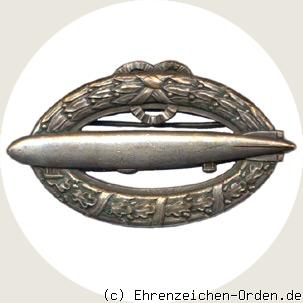 Front side: commemorative signs for paratroopers of the ground forces
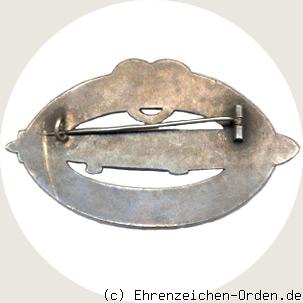 Reverse: Commemorative sign for paratroopers of the ground forces
Established:
August 1, 1920 Minister of the Reichswehr Otto Gessler
Data:
- Material: silver-plated copper alloy, partially painted
- Size: 69mm x 39mm
- Weight: about 40g
estimated collector price:
1800 - 1900 € silver plated in bronze

 Awards of World War II