Germany Awards - Insignia for Observers on Naval Aircraft
The badge for observers on naval aircraft was established on May 28, 1915 by the Kaiser and King William II. donated. By analogy with the badge already donated in 1914 for observation officers from aircraft, a separate badge was created for the Navy. Executive Regulations were issued on June 10, 1915. Relying on the provisions for aircraft commanders, the badge could only be worn as long as the Belgian was as an observer on the imperial maritime department's list. A prerequisite was a 15-hour flight as observers over water or land. Skills and knowledge to be demonstrated included knowledge of the engine and its repair, navigation and compass training, communication training such as flag waving, fruit drinks and radio, handling of various drop items. Naval knowledge was also required. These were, among other things, knowledge of various types of ships, the tactical structure of the fleet and general seaworthiness.
The signs were made of silver and bronze with gilding. A well-known manufacturer is H. Schaper.
A tall oval, a massive gilt bronze sign. Gaps in the crown are cut. The reverse is smooth with a perpendicular pin with a mating hook. The manufacturer hit the needle.
Front side:
- The edge is formed from a wreath open from above, tied from below with a loop.
- On the left is laurel and on the right is oak foliage. From above, he passes into the imperial crown.
In - the surrounded field, slightly to the right of the rock on which the white-tailed eagle sits.
- The eagle in the center with its wings down looks to the right.
- Near the rock is water with 3/5 of the sun standing on the horizon with short rays.
- In the background is an image of clouds above the sun and behind the eagle.
Downside:
- Smooth and gilded with perpendicular needle and locknut.
- On top of the crown is a small bow.
- The manufacturer, H. SCHAPER, got on the needle.
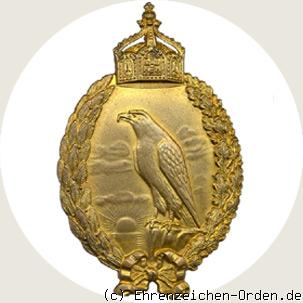 Front side: signs for observers on naval aircraft
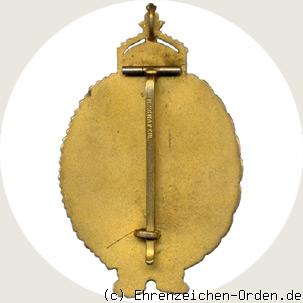 The Flip Side: Badges for Observers on Naval Aircraft
Established:
May 28, 1915 King and Emperor William II.
Data:
- Material: Bronze gilded
- Size: 72mm x 47.5mm
- Weight: about 44g
estimated collector price:
1400 - 1500 € silver gilded
1200 - 1300 € bronze with gilding

 Awards of World War II