Germany Awards - Silesian Mark 1st Class with Screw Washer
The Silesian Parole Badge, also referred to simply as the Silesian Eagle, was awarded by Commander General VI. The Army Corps was formed on 16 June 1918. The design of the badge of honor was developed by the Breslavl sculptor Professor Theodor von Gozen. It was awarded to all fighters involved in the defense of the Silesian homeland in 1918 and 1919. This award consisted of 2 classes. 2nd class for 3 months of service and 1st class for 6 months of service in this unit. The badge of honor had to be paid by the loanee himself. The award was to end in 1919. But with the 3rd Polish Uprising of 1921, the awarding was resumed by the self-defense of Upper Silesia. In 1921, Lieutenant General Höfer supplemented this award with swords and oak leaves. Thus, a total of 8 different levels were created: 2nd class, 2nd class with oak leaves, 2nd class with swords, 2nd class with swords and oak leaves, 1st class with oak leaves, 1st class with swords, 1st class with swords and oak leaves. Enameled and silver-plated products date back to the period after 1921 and are the subject of purchase and sale for private needs.
In 1933, the Silesian Eagle was recognized as a state award and can be worn in the Federal Republic of Germany. Source: Ingo G. Harke, Awards of the German Volunteer and Volunteer Forces 1918-1921. and their successor organizations, 2019.
A sign in the form of a standing eagle made of silver-plated bronze, with his head to the right. Eagle silver burgundy and black enameled. The back is smooth and silver-plated. In the center is a standing elongated nut with a screw washer.
Front side:
- On the chest lies a silver crescent, in the center of which is a cross.
- The legs rest on a curved ribbon with the inscription: - FOR - SILESIA -.
Downside:
- Smooth and silver plated. Helical washer with radiation pattern.
- Alternately deepened and raised rays. Raised cross-hatched.
Photos of www.militaria-berlin.de
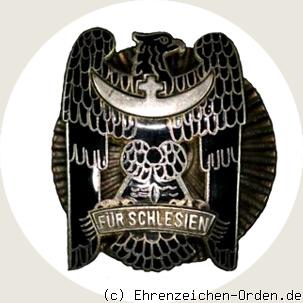 Front side: 1st class sign with screw washer
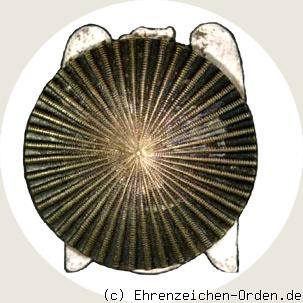 Reverse: Class 1 sign with screw washer
Established:
June 16, 1919 General Command VI. Army Corps
Data:
- Material: Bronze/enamelled
- Size: about 43mm x 32mm
- Weight: about 16g
estimated collector price:
230 – 250 €

 Awards of World War II