Germany Awards - Langemark - Cross
The Langemark Cross was established with the permission of Adolf Hitler in 1933 by the Green Corps Partnership. 26th Reserve Corps of Cologne." The Green Corps was an association of former Langemark fighters with more than 80 local groups. The head of the association was the adviser to the district court, Dr. Hans Brass, who also signed the relevant documents. Reserve infantry regiments 233-240 and infantry artillery regiments 51 and 52 were eligible. The name "Green Body" comes from the green ribbons worn around the axillary valves.
The Battle of Langemark in a village in Flanders on 21 October 1914 was later turned into a myth and glorified as a "sacrificial move of German youth" by the Nazis. The myth arose from the fact that volunteers had to consist of many students, and as a result of heavy losses, 2,000 prisoners were taken and 6 machine guns were captured. The actual composition of the regiments did not confirm the disproportionate participation of students or youth. At the Battle of Ypern, the regiments were assigned to the 51st Reserve Division under Lieutenant General Ferdinand Wenker von Dankschweil. With artillery support, RIR 235 (Koblenz) under the command of Colonel von Gilza was to attack in the south, and RIR 236 (Cologne) under the command of Colonel Wilhelmi in the north. The failure of command and disorganization led to real chaos. The troops obstructed each other, concentrating in a narrow space. Due to insufficient reconnaissance, the German units suffered very heavy losses. RIR 235 lost about 1,900 personnel out of 2,700. Although the singing of the "German song," reduced to glorification, was sung, it, according to modern data, served more to ensure the orientation of the soldiers, and not as an "assault song." As an expression of veneration, "Langemark commemorative events" organized by the Reichskriegerbund and the National Socialist Student Union were held in National Socialism.
The exact figures for the award are unknown, but can be obtained from the membership of local clubs (which I do not know). Crosses were made of silver-plated/patinated iron sheet and patinated silver.
A hollow relief sign made of a silver-plated sheet of iron or silver. On the back is a vertical round pin with reciprocal hooks.
Front side:
- Smooth St. George cross with beveled edges.
- Across the middle cruciform levers rises the inscription - LANGEMARCK -
- Which - L - obscures the bottom line of the letter - A -.
- On the lower cruciform shoulder increased 2-line - 26. - (large) -/- Res. - K.- (smaller).
Downside:
- Needle foot of round needle is fixed with quadrangular plate.
- The counterhook is soldered by a round plate.
- Consider the front side font as negative.
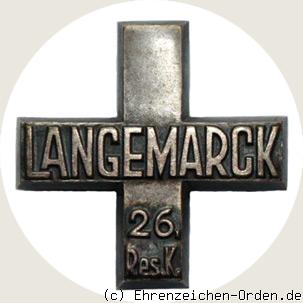 Front side: Langemark - cross
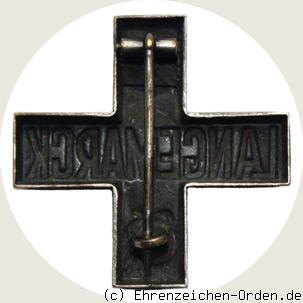 Reverse: Langemark - cross
Established:
In 1933 he joined the Green Corps. 26th Reserve Corps, Cologne
Data:
- Material: silver-plated/patinated iron sheet
- Size: 42mm
- Weight: 10.15g
estimated collector price:
80 – 100 €

 Awards of World War II