German Awards - Baltic Landeswehr Strike Group Armband
This sleeve sign was worn by servicemen of the Baltic Landeswehr strike squad. Sleeve signs were worn because uniforms at freikorps, unlike former regular units, were not always uniform. They often wore the uniform of the former unit or collected any parts of the uniforms of various units or used other private clothes. Preserved sleeve insignia are extremely rare.
The Baltic strike forces were created on November 17, 1918 by Captain Bohm. In late December - early 1919, the strike group participated in the unsuccessful defense of Riga from the advancing troops of the Red Army. After retreating from Riga, Lieutenant Hans von Manteuffel-Söge became the commander of the strike group (at a special disposal) and formed it into the best unit in the Baltic Landeswehr. On April 16, 1919, he led an attempted coup against the Latvian government led by Karlis Ulmanis. In May 1919, he led the liberation of Riga, during which he fell on May 22. After Manteuffel's death, the unit was disbanded. Hans von Manteuffel-Söge was considered by many to be the most capable military and political leader of the German Balts. For a long time after his death, he was highly respected.
The Baltic Landeswehr was created by order of the government council of the Baltic Duchy on November 8, 1918 in Latvia. The order was signed on November 11, 1918 by Lieutenant General G. von Katen. Landeswehr was subordinate to the German occupation authorities. Salaries and armaments were also adopted by the German Empire until July 1919. The Baltic Landeswehr fought in the Baltic states for liberation from the Red Army, which in 1919 occupied Riga. Among the fighters were numerous Baltic-German volunteers. The Baltic Germans in the German army were transferred to the Landeswehr. Other volunteers were recruited in the German Empire. They were to receive Latvian citizenship and settlement land under an agreement with the Ulmanis government. By May 1919, the number of the Baltic Landeswehr had grown to about 6,100 people. The commanding officer was Major Alfred Fletcher. Since February 1919, Landeswehr was subordinate to the VI Army. Reserve Corps under Rüdiger von der Goltz. May 22 managed to free Riga. After the Battle of Cesis against the Estonians and the Strasdengof Armistice Treaty of July 3, it was decided that the Landeswehr would be subordinate to the Latvian High Command. German volunteers had to leave the union. Also, the Latvian brigade of Colonel Balodis and the Lieven detachment left the Baltic Landeswehr. After fighting on the Soviet front until 1920, the Landeswehr was reorganized into the Latvian 13th Tukum Infantry Regiment on April 1, 1920 and disbanded.
High oval, openwork sleeve badge made of non-ferrous metal. Above and below there are 2 holes for sewing to the fabric substrate.
Front side:
- The edge is formed from a 3-row oak-leaved wreath.
- At the bottom, it ends with a curved shield, which is painted black, white and red.
- To the right and left of the shield, one hole through which the sign is sewn.
In the - center of the openwork field, a hand holds a vertically standing sword.
- A straight paired bar with balls at the ends reaches the edge.
- The point of the sword is superimposed on the edge and protrudes little above it.
- To the right and left of the blade is the hole through which the sign is sewn.
Downside:
- The threads with which the badge is sewn are visible from behind.
.
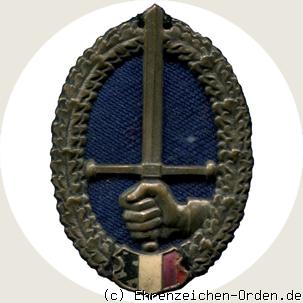 Front side: sleeve insignia of the Baltic Landeswehr strike group
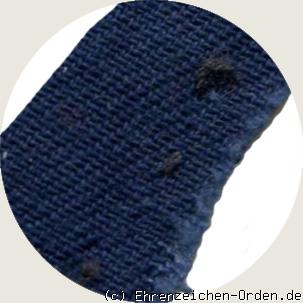 Reverse: Baltic Landeswehr Strike Group Sleeve Mark
Established:
Around 1920, the Commission on Orders/General Staff of the Baltic Landeswehr
Data:
- Material: non-ferrous metal, partially painted
- Size: 50.79mm x 35.15mm
- Weight: 4.5g (with cloth)
estimated collector price:
Unspecified

 Awards of World War II