Awards of Germany - Honorary Cross of the Baltic Landeswehr with a sword
The Baltic Landeswehr Cross of Honour was established in 1920. Former servicemen of the Baltic Landeswehr with and without a sword were awarded an honorary badge. It can be assumed that the front-line fighters received a cross with a sword. The cross was awarded with a document showing the award number at the bottom. The number awarded with a sword is about 3200, and without a sword - about 1600.
The Baltic Landeswehr was created by order of the government council of the Baltic Duchy on November 8, 1918 in Latvia. The order was signed on November 11, 1918 by Lieutenant General G. von Katen. Landeswehr was subordinate to the German occupation authorities. Salaries and armaments were also adopted by the German Empire until July 1919. The Baltic Landeswehr fought in the Baltic states for liberation from the Red Army, which in 1919 occupied Riga. Among the fighters were numerous Baltic-German volunteers. The Baltic Germans in the German army were transferred to the Landeswehr. Other volunteers were recruited in the German Empire. They were to receive Latvian citizenship and settlement land under an agreement with the Ulmanis government. By May 1919, the number of the Baltic Landeswehr had grown to about 6,100 people. The commanding officer was Major Alfred Fletcher. Since February 1919, Landeswehr was subordinate to the VI Army. Reserve Corps under Rüdiger von der Goltz. May 22 managed to free Riga. After the Battle of Cesis against the Estonians and the Strasdengof Armistice Treaty of July 3, it was decided that the Landeswehr would be subordinate to the Latvian High Command. German volunteers had to leave the union. Also, the Latvian brigade of Colonel Balodis and the Lieven detachment left the Baltic Landeswehr. After fighting on the Soviet front until 1920, the Landeswehr was reorganized into the Latvian 13th Tukum Infantry Regiment on April 1, 1920 and disbanded.
Awarded honorary crosses were made with a screw disc. An award number is engraved on the lower cruciform hand. In the case of a cross with the manufacturer, it can be found on a screw washer or as an abbreviation on the lower cross. Famous manufacturers were: MAKSL.GRAVES.JEST J.EDELHAUS RIGA, W. LAMPE LEBECK also with the abbreviation WL and the silver brand, W. MÜLLER POSEN. Screw discs without a manufacturer are also known. The size and shape of the nuts, with and without a counter plate, vary greatly. The sizes of the crosses range from 41 to 40 mm. In the mid-20s and 30s, crosses with a pin were also made. Silver specimens are probably private owners. Also known are the plays of Gaudet, Berlin. Miniatures and half-measures were also produced. It measures between 18 and 22 mm. Such pieces with an eye, needle and screw disc are known.
Non-ferrous metal silver cross. The cross shoulders of the front side are enameled. In the center is a shield with a sword standing behind. The back side is smooth and silver plated in the center of the threaded pin and screw washer.
Front side:
- The cross arms are edged with silver. Subsequently, a wide light blue enameled rim.
- The inner sides of the cruciform sleeves are enameled in white and outlined to the edge with a narrow line.
In the - center is a pointed silver shield with a black enameled cross.
- Behind the shield in the center is a vertically standing sword. The handle lies on the upper cruciform shoulder.
- The blade lies on the lower cruciform shoulder.
Downside:
- Smooth and silver plated. Threaded stud is applied in the center.
- The award number is engraved on the lower cross - 3129 -.
- Non-manufacturer screw washer with bent side ends.
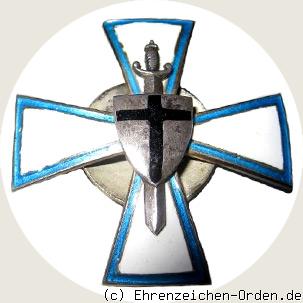 Obverse: Baltic Landeswehr Sword Cross of Honour
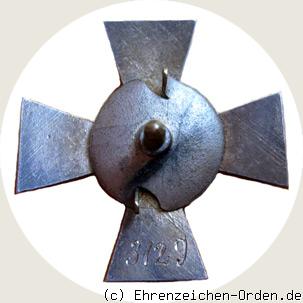 Reverse: Honorary Cross of the Baltic Landeswehr with a sword
Established:
circa 1920 by the commission on the order/main headquarters of the Baltic Landeswehr
Data:
- Material: non-ferrous silver-plated metal, enamel
- Size: 40mm, nut 20.5mm
- Weight: 15g
estimated collector price:
400 – 450 €

 Awards of World War II