Awards of Germany - Sign of self-protection of Upper Silesia S.S.O.S.
The Upper Silesia Self-Defense (S.S.O.S.) sleeve insignia was probably introduced in May 1921 by the union leader, a retired lieutenant general. Carl Höfer submitted (or donated). The badge was worn by members of various German volunteer corps, which united to oppose the 3rd Polish uprising. Karl Höfer was its leader from May 20 to July 5, 1921.
The starting point of the 3rd Polish uprising was the plebiscite in Upper Silesia. Due to the Anglo-Italian proposal for the division of the territory, the Percival de Marinis line, which wanted to leave Germany 3/4 of the territory, including industrial areas, the Polish side decided to rebel. Wojciech Korfanta was a former deputy of the Reichstag and after the First World War returned to the recreated state of Poland. There he organized Polish uprisings. The secret Polish military organization POW with its volunteer corps caused the 1st and 2nd Polish uprising in 1919 and 1920. Both of them were defeated. To calm the situation, a plebiscite was held, which, however, did not bring the desired result.
On the Polish side, the uprising was led by Colonel Count Maciej Melzyński. He occupied territories that, after Corfanta, were to pass to Poland. The German resistance as Upper Silesia's self-defense alliance S.S.O.S. opposed the Polish rebels. In the battle of St. Annaberg on May 21-27, 1921, German volunteer corps won. As a result, a truce followed. The Inter-Allied Government and Plebiscite Commission for Upper Silesia, a post-World War I control body, negotiated. The conference of ambassadors on October 20, 1921 in Paris decided to divide with industrial areas on the Polish side.
Curved pointed shield made of hollow knocked out non-ferrous metal. The upper corners are beveled. The wide edge is equipped with stylized, raised rivets around the circumference. The shield is silver plated diagonally from below and golden from above. The diagonal stroke is combined. On top of the beveled edges there are 1 hole, and on the lower end there are 2 holes for rapprochement.
Front side:
- On the side on the wide edge there are 7 rivets on the right and left. 8 rivets on top.
- In the center, perpendicular to the elevated embossed standing sword. The round end of the button lies on the edge.
- The parry rod is bent down, in the center is a triangle standing at the apex.
- Behind the sword are sinuous, embossed snakes.
- On the left, 3 snakeheads protrude to a height, on the right, 2 snakeheads and a tail.
- The diagonal line between the silver and gold parts runs from bottom left to top right.
- Three heads on the left in a golden area. Right head and tail in a silver area.
Downside:
- Negative front. No color delimitation.
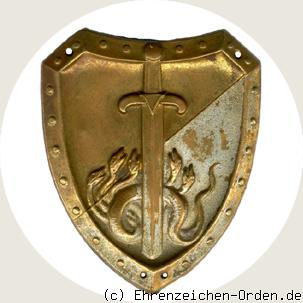 Front: Upper Silesia Self-Protection Mark S.S.O.S
.
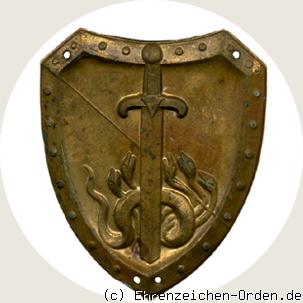 Reverse side: Upper Silesia self-protection sign S.S.O.S.
Established:
May 1921, retired lieutenant general. Carl Höfer
Data:
- Material: non-ferrous metal silver-plated/gold-plated
- Size: 48mm x 41mm
- Weight:
estimated collector price:
120 – 150 €

 Awards of World War II