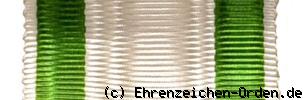
Awards of Germany - Order of Merit Silver Cross "For Merit" without swords
The Order of Merit was established by King Frederick Augustus back in 1815 as a civil order of merit. Initially, the order was divided into 3 classes: the Grand Cross, Komtur and the Knight's Cross. Unofficially, the Civil Medal was considered the 4th class. In 1849, the order was renamed the Order of Merit and expanded to 5 classes. These included the Grand Cross, Komturkreuz 1st Class, Komturkreuz 2nd Class, Knight's Cross and Small Cross. For this, he received gold and silver medals. Foreigners were awarded the order with a different inscription on the reverse. (For merit) In 1858, the Small Cross was renamed the Honorary Cross. Swords for military merit were instituted for all classes in 1866. The swords on the ring were presented by King Johann only in 1870 for holders of the "Mir" class cross, who subsequently received military merit or for those who received a higher class but previously had lower-class military decoration. In 1876, there was a change in statutes. The knight's cross was divided into the 1st and 2nd. The class is divided. The honorary cross was no longer awarded and could be exchanged for the Knight's Cross of the 2nd class. For the gold medal "For Merit," the cross "For Merit" was established. An exchange was also possible. The new 6 classes were: Big Cross, Komtur 1st and 2nd. Class, 1st and 2nd class knights. Class and Merit Cross.
In 1891, as a final extension, the golden crown was given to the Grand Cross and Comtur. The breast star of the Grand Cross became 8-ray.
The Silver Cross of Merit was awarded without swords for civil merit and with swords for military merit. During the award period, 2 forms came to the award. The 1st form has a medallion of several parts and is about 1 mm larger and somewhat heavier. (up to 14 g) 1st form was awarded until 1910. The circulation is about 2,400 copies without swords. Swords were awarded only 4 pieces in return for the gold medal "For Merit." The 2nd form is knocked out of a single piece and slightly smaller and lighter. This form was awarded from 1911 to 1918. About 2,300 were produced. These crosses were also awarded to women on the so-called women's loop. Source: J. Nimmergut, Deutsche Orden und Ehrenzeichen bis 1945, vol. III, 1999.
Eight-pointed silver cross. Cruciform shoulders with wide, raised edges. The inner sides of the cross sleeves are finely cut. Front and rear with a round central shield. Between the apices of the upper cruciform shoulder is an angel-shaped ordinary ring with a ribbon ring.
Front side:
- Round central shield with a wide raised ring.
- Inside and outside, it is bounded by one edge.
- The ring bears the inscription: - FR. - AUG. - K. - V. - SAXONY -
- - D. - 7. - JUNE - 1815 - 6-ray star at the bottom.
In - a surrounded recessed field is a crowned Saxon coat of arms.
Downside:
- The edge of the middle shield is formed by an oak-broad-leaved wreath.
In - a closed, finely cut field, 4-line font:
- - FOR -/- MERIT -/- AND -/- FIDELITY -
Tape:
- 35 mm wide, white edges, with green side stripes of 6 mm
.
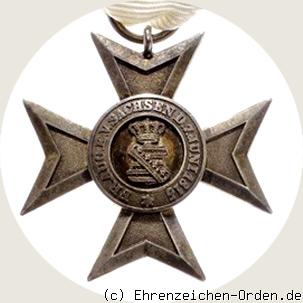 Obverse: Order of Merit Silver Cross of Merit without swords
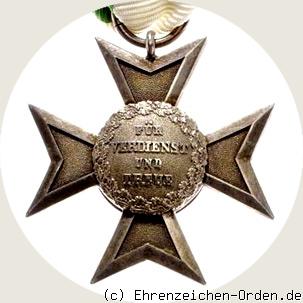 Reverse: Order of Merit Silver Cross of Merit without swords
Established:
January 31, 1876 by King Albert
Data:
- Material: Silver
- Size: about 35mm
- Weight: about 13.5
estimated collector price:
300 – 350 €

 Awards of World War II