Germany Awards - Gang Rescue Medal
On September 18, 1925, the Angolan State Ministry decided to create a rescue medal on the ribbon. In paragraph 5 of Article 109 of the Constitution of the German Empire of August 11, 1919, the presentation by the state of orders and honorary badges was prohibited. Only after other states such as Baden, Mecklenburg and Württemberg and finally Prussia established portable rescue medals did Anhalt also become a foundation. Persons were awarded for actions of general sacrifice, associated with a particularly significant danger to the life of the rescuer or thanks to which a very important success was achieved. Until the age of 18, the award was suspended and, in addition, the person should be considered worthy of the award. The presentation was attended by a certificate that spoke of salvation. The award was non-refundable. At the same time, a commemorative medal for escape from danger was established, which was awarded to rescuers where the danger to their own lives was not so significant. Nothing is known about the design and manufacture. Scharfenberg gave only 4 awards, which were published in the Anhaltische Staat-Anzeiger. The material in Nemngut (silver) is incorrect. Medals are silver, matte patinated. Source: Gerd Scharfenberg, Order and Badge of Honor of the Anhalt States, 1999.
High-oval, cast medal made of matte silver-plated copper alloy with slightly raised narrow edges. A cast wide ironing eye (14.5 mm) on top for pulling the tape.
Front side:
In the - center there is a horizontal stone wall with 5 rows of stones and 4 teeth, in the center there is an arched gate.
- A bear without a collar and crown shouted to the left on its teeth, raising its right front claw.
- Under the wall is two-line, elevated - FREE STATE -/- ANHALT -.
Downside:
- Distributed in the center into four lines - FOR -/- RESCUE -/- OFF -/- DANGER -.
Tape:
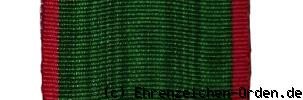
37 mm, dark green with 2.5 mm width dark pink side stripe
Photo: Private collection of Maximilian Ferdinand Leopold Prince of Anhalt
.
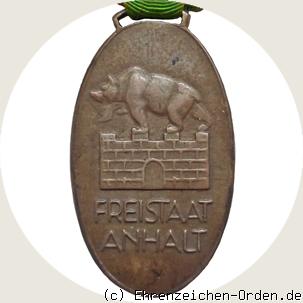 Front: Gang Rescue Medal
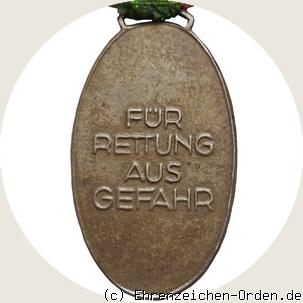 Reverse: Ribbon Rescue Medal
Established:
September 18, 1925 by the State Ministry of Anhalt
Data:
- Material: matte silver-plated copper alloy
- Size: 29.07mm x 51.1mm
- Weight: 31.1g (with tape)
estimated collector price:
Unspecified

 Awards of World War II