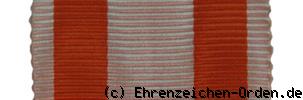
Awards of Germany - Jubilee Kurgessen commemorative coin November 23, 1813-1913.
King and Emperor Wilhelm II. July 4, 1913 established commemorative medals for the former Elector Hessian military units. They were either defined by order of January 24, 1899 as a tribe of Prussian troops, or were members of the electors of the Hessian cavalry troops, the Guard Corps, the 1st and 2nd. served in the hussar regiment.
The occasion was the 100th anniversary of the regiments. 4 different medals were presented with the same front and different backs for the respective troops. The medals were struck in Berlin by Otto Ertel. Medals at the anniversary celebration were awarded only to the present servicemen or in their undeserved absence. Medals with a reverse inscription on November 23, 1813-1913 were awarded only to the hussar regiment of Landgrave Frederick II. awarded Hesse-Homburg, (2nd Kurhessish) No. 14. With only 83 awards, this option is the rarest of the 4 commemorative medals.
After 1866, the Kurgess cavalry was formed into 2 regiments. The 2nd Kurges Hussar Regiment was included in the Prussian Army as Hussar Regiment No. 14. During the Franco-Prussian War of 1870/71, the regiment fought as part of the 21st Division at Weissenburg, Wörth and during the siege of Paris. The regiment was the first to move to the French capital. Some troops subsequently enlisted in the guard detachment and fought in China and German Southwest Africa.
The medal is round in bronze with a narrow, raised border. Above is a soldered ordinary eye with a ribbon ring.
Front side:
In the - center of the pedestal is a lion lying on the left with its head down.
- The tail of the lion after swinging in front of it is superimposed on the pedestal.
- Under the pedestal in the depression 2 crossed, strong oak-deciduous branches.
Downside:
- On a smooth bottom, 3-line font - 1813 -/- 23. NOVEMBER -/- 1913 -.
- In addition to annual numbers on the left and right, one small branch of oak leaves 3 pieces.
Tape:
white 35 mm, white edges 2.5 mm, orange side stripes 7 mm.
.
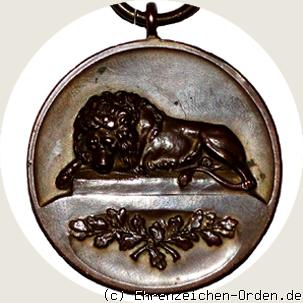 Obverse: Jubilee Kurgessen commemorative coin November 23, 1813 - 1913
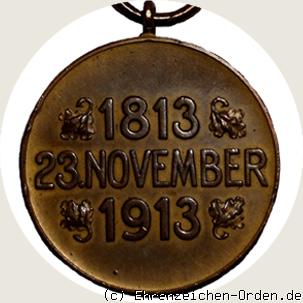 Reverse: Jubilee Kurgessen commemorative coin November 23, 1813 - 1913
Established:
July 4, 1913 by the king and emperor William II.
Data:
- Material: Bronze
- Size: 40mm
- Weight: 35.1g
estimated collector price:
without indication

 Awards of World War II