Awards of Germany - Small noble decoration
Small noble decorations were established on August 20, 1808 by King Frederick I of Württemberg. This award was awarded without any merit only on the basis of origin or class.
Frederick I wanted to create his own decoration or order for all the truly noble owners of estates and family elders of the kingdom. The families awarded were listed by name, which is also exceptional and, to my knowledge, unique. Deliberate families were listed separately by counts and barons.
Among the counts were: Adelmann to Hohenstatt, Beroldingen, Bissingen-Nippenburg to Schramberg, Enzenberg to Singen, Görlitz, Norman-Ehrenfels, Stauffenberg to Geisslingen, Schenk Castell and from stadium to stadium
Among the free masters were: from Bautz to Edheim, from Berlichingen, from Bodmann to Bodmann, from Bodmann to Schlatt, from Buvinghausen, from broadswords, from Bubenhoven, from Buol-Mühlingen, from Erzberg to Mülheim, von Freiberg-Almendingen, von Freiberg-Hürbel, von Freiberg-Wellendingen, von Geisberg, von Geisberg-Helfenberg, from Geisberg-Schöckingen, from Gemmingen-Bürg, from Gemmingen-Prestenk, from Gemmingen to Steinsfeld, from Gemmingen-Fürfeld, from Gemmingen to Bonfeld, from Gültingen to Berneck, from Hiller to Gertringen, from wood to Alfdorf, from Hornstein-Greeningen, von Hornstein-Hohenstoffeln, von Kechler in Unterschwandorf, von Knistedt, von Lang in Leinzell, von Liebenstein, von Massenbach, von Linden, von Münchingen, von Pach-zu-Oberhausen, Palma to Esslingen, Rakwitz to Laibach, Rassler to Gamerswang, from Rechberg, from Reischach to Hohenkrachen, from Reischach of Riedt, Reutner von Weil, from Röder to the Moors, Schott von Schottenstein, from Späth-Granheim, from Stein to Harthausen, from Stetten-Buchenbach, from Stotzingen from Ulm to Werenwag, from Uksküll of Eschenau, from Warenbühler, from village to village, from Velds to Gross-Laupheim, from Velds to Kleinlaupheim and from repetitions.
The badge of honor was awarded only from 1808 to 1817. 66 awards are reported, of which only a part has survived. As is often the case with such old orders and badges of honor, it is not entirely clear what an obverse is. I proceed from - FR - the name of the founder.
Eight-pointed cross made of gold. The cruciform shoulders have smooth, golden edges. The inner sides are covered with white enamel. Front and back with raised round gold medallion. Between the tips of the upper cruciform shoulder is a parallel, arched ear through which passes a strong, angular ligamentous ring.
Front side:
- A medallion with a smooth, raised border. The enclosed field is finely combed.
- The central decorated, enlarged combination of letters - FR - for Frederick Rex (King Frederick).
- Above it is a large 5-curved crown (in simple representation).
Downside:
- A medallion with a smooth, raised border. The enclosed field is finely combed.
In the - center intersects the big letter - W -, middle strokes.
- Above it is a large 5-curved crown (in simple representation).
Tape:
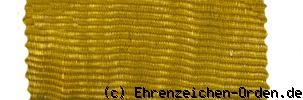
yellow 35 mm wide.
The photos were taken with the support of Nagel auction house, Stuttgart .
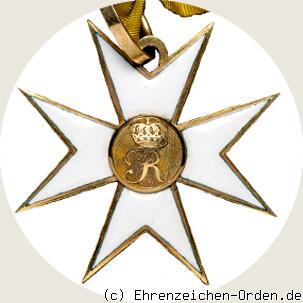 Front side: Small noble decoration
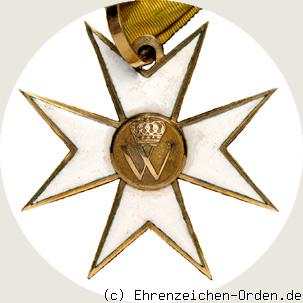 Reverse: Small nobility decoration
Established:
August 20, 1808 by King Frederick I.
Data:
- Material: gold, enamel
- Size: 45mm
- Weight: 26g
estimated collector price:
21.000 – 23.000 €

 Awards of World War II