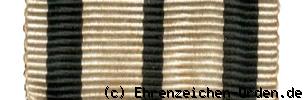
German Awards - Bene Merenti 1910 Small Gold Medal
The Hohenzollern Bene Merenti Princely Medal ("For Good Offices") was established in 1857 by Prince Karl Anton von Hohenzollern-Sigmaringen. The medal was intended to be awarded for cultural merit. The medal was initially unbearable and was awarded in 2 sizes, 41 mm and 30 mm. The Bene Merenti Medal took place inside the Order of the Hohenzollern House between the Silver Cross of Merit and the Gold Medal of Honor of the Order of the House. The first medals under Prince Karl Anton have the inscription: CAROLUS ANTONIUS PRINCEPS DE HOHENZOLLERN. Under Prince Leopold, the obverse with the image of the prince and the decoding changed: LEOPOLDUS PRINCEPS DE HOHENZOLLERN. Gold medals were awarded 43 and 13 times, respectively. Small gold medals under two princes were also awarded only 75 and 20 times, respectively. The stamp carver was W. Kulrich from Berlin. The supplier of medals minted at the Berlin Mint was Friedeberg & Söhne in Berlin.
After the assumption of office of Prince Wilhelm in 1905, the medal was again equipped with a new front side. The prince, with the permission of Emperor William II, changed the medal to a portable badge of honor. Awarding was now carried out to persons from the environment of the princely court and princely ladies of the high nobility. New stamps were cut by O. Schulz. Under Prince William, only one large gold medal was minted, which was not awarded. In total, the medal was awarded 53 times. Of these awards, 30 medals were received by women. Among them were only 6 artists. Source: Jörg Nemmergut, German Orders and Insignia until 1945, vol. I, 1997.
Gold medal with raised border. On top is a soldered, ordinary eye with a ribbon ring.
Front side:
In the - center is a portrait of Prince William, facing left.
- On the margins is the inscription: - GUILELMUS - PRINCEPS - DE - HOHENZOLLERN -.
In the - neck part there is a small stamping cutter - O.SCHULTZ 07 -.
Downside:
- At a short distance from the edge is a dense, cross-linked oak-deciduous wreath above and below.
- In the included field, the 2-line raised font is BENE -/- MERENTI -.
- Below it is a horizontal strip.
Tape:
- 30 mm wide, white edges 1.5 mm, black side stripes 4 mm, black central stripes 3 mm.
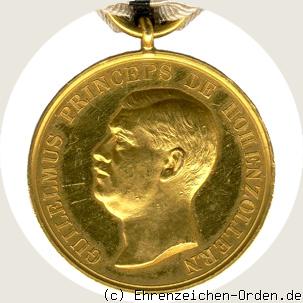 Front: Bene Merenti 1910 Small Gold Medal
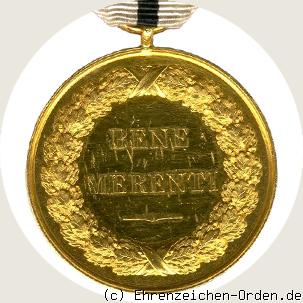 Reverse: Bene Merenti 1910 Small Gold Medal
Established:
1857 Prince Karl Anton von Hohenzollern-Sigmaringen
Data:
- Material: Gold
- Size: 30mm
- Weight: 21.4g
estimated collector price:
1600 – 1800 €

 Awards of World War II