German Awards - Gold Medal of Merit 2. Model
The gold medal "For Merit" was 1897 as the highest degree by Prince Henry XIV. A junior line was created. The designation, a merit medal affiliated with the princely honorary cross, was officially introduced. At first, the gold medal "For Merit" was awarded only in the principality of the younger line. Awarding on the senior line of the Principality of Reuss has been carried out since 1902. The princely Reusian honorary cross was established on May 24, 1869 in 3 classes. As of 1885, the order already consisted of 4 classes: 1st class, 1st class with a crown, 2nd class, 3rd class and a silver medal "For Merit." After expansion in 1897 with the gold medal "For Merit," the order in 1909 was expanded to 6 classes. To this were added the Officer's Cross and 4th grade. The award with the crown was introduced as a special promotion for the remaining classes (except the Officer's Cross) and the Gold Medal of Merit. This is in the color of the stage, so gold or silver. Swords were donated for military services in 1909. Starting in 1915, merit medals could also be awarded with a military merit ribbon. This applies to all medals with and without swords. The ribbon received medals without swords for merits at home. Ranks established since 1915 provided for the gold medal "For Merit" awarding officer ranks-representatives, junior foremen, sergeant major with more than 12 years of service and equivalent to the rank of military personnel and junior officers. Source: J. Nimmergut, Deutsche Orden und Ehrenzeichen bis 1945, vol. II, 1997.
Gold-plated silver medal with raised border. Above, a soldered ordinary eye and a ribbon ring.
Front side:
- On the edge is a circular pearl thread.
- Inside a laurel wreath with fruits tied from below with a bow, the inscription:
- - For -/- merit - with a fracture, including a horizontal decorative line expanded in the center.
Downside:
- On the edge is a circular pearl thread.
The - letters - H - R - are intertwined and decorated in the center.
- Letter - R - cross-hatched. Above is a semi-laid 5-arc crown.
Tapes:
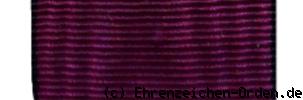
Civic Merit: 30mm, Purple (Amaranth Red)
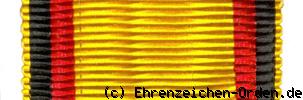
Military merit: yellow 35 mm wide, edges 1 mm, side stripes black and red 3.5 mm each.
.
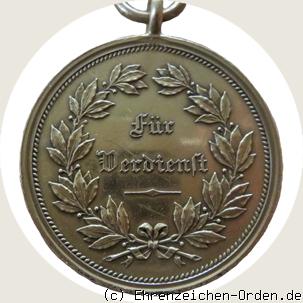 Obverse: Gold Medal of Merit 2. Model
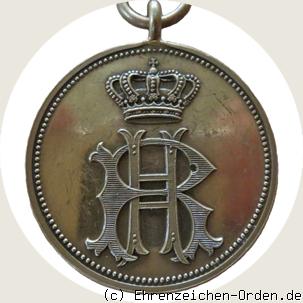 Reverse: Gold Medal of Merit 2. Model
Established:
In 1897, Prince Henry XIV. The younger line of Royce
Data:
- Material: Silver gilded
- Size: 32mm
- Weight: 16.6g
estimated collector price:
280 – 300 €

 Awards of World War II