German Awards - Gold Medal of Merit 2. Sword model
The Gold Medal of Merit with Swords was awarded primarily during World War I. Medals with swords were awarded to soldiers who served in military units, the head of which was the prince, or subjects of the Principality of Reiss of the younger line, who served in other troops and in the navy. The gold medal "For Merit to the Principality" was awarded in 1897 by Prince Henry XIV. Established as the highest level of the Silver Medal for Merit, introduced already in 1885. The princely Reusian honorary cross was established on May 24, 1869 in 3 classes. As of 1885, the order already consisted of 4 classes: 1st class, 1st class with a crown, 2nd class, 3rd class and a silver medal "For Merit." After expansion in 1897 with the gold medal "For Merit," the order in 1909 was expanded to 6 classes. To this were added the Officer's Cross and 4th grade. The award with the crown was introduced as a special promotion for the remaining classes (except the Officer's Cross) and the Gold Medal of Merit. This is in the color of the stage, so gold or silver. Swords were awarded for military merit. The crosses crossed through the center, and the medals shown here crossed over the medal. The award of the gold medal "For Merit" assumed the title of sergeant major, vice sergeant major with more than 12 years of service, representative of an officer position or ensign. The exact figures are not known as they have not been made public. Source: J. Nimmergut, Deutsche Orden und Ehrenzeichen bis 1945, vol. II, 1997.
Gold-plated silver medal with raised border. 2 crossed, antique swords pass through the corrugated eye. At the intersection of the swords at the top is a segment with an eye and a ribbon ring.
Front side:
- On the edge is a circular pearl thread.
- Inside a laurel wreath with fruits tied from below with a bow, the inscription:
- - For -/- merit - with a fracture, including a horizontal decorative line expanded in the center.
Downside:
- On the edge is a circular pearl thread.
The - letters - H - R - are intertwined and decorated in the center.
- Letter - R - cross-hatched. Above is a semi-laid 5-arc crown.
Tape:
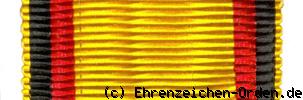
- yellow 35 mm wide, edges 1 mm, side stripes black/red 3.5 mm each.
.
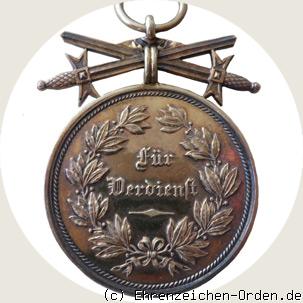 Obverse: Gold Medal of Merit 2. Sword model
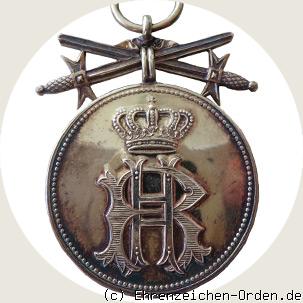 Reverse: Gold Medal of Merit 2. Sword model
Established:
In 1897, Prince Henry XIV. The younger line of Royce
1909 Foundation of the crown and swords
Data:
- Material: Silver gilded
- Size: 32mm, swords 34 x 2mm
- Weight: about 19g
estimated collector price:
400 – 450 €

 Awards of World War II