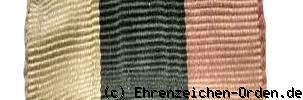
German awards - Battle Cross for 1813-1815.
The cross was presented on 5 February 1823 by Duke Leopold IV. of Anhalt-Dessau. The duchies, which had been part of the Union of the Rhine since 1807, first fought for Napoleon in Tyrol, Spain and Russia. In 1813, Anhalt-Dessau and Anhalt-Köthen decided to oppose Napoleon and created a joint jaeger battalion. After the return of the troops of 1814 as a reward, Duke Leopold III issued a ribbon in the national colors white/red/green. established on February 26, 1815. This ribbon was to be given as a reward to volunteer hitchhikers who had campaigned against France and had conscientiously established themselves and behaved morally well. After the final end of the 1815 campaign, the pool of eligible individuals was expanded. Now all members of the Dessau troops, who were part of the Dessau troops during the war and entered the French land and served faithfully on it, had the right to be awarded. The tape itself was unsuitable for awards from the very beginning and was perceived that way. Duke Leopold IV. Therefore, he decided that the ribbon should not be worn alone, and therefore established the military cross shown here. Special charters were not adopted, so that the rules for assigning a volume continued to apply. The wreath between the cross sleeves was originally painted green. Additional crosses were issued for the 50th anniversary of 1863 or made in return. This is irrelevant in the evaluation, as the paint coating was probably not very strong. The circulation was about 1068 copies. The cross was awarded without distinction of position to officers, non-commissioned officers and soldiers.
Light bronze cross with flared cruciform sleeves. The edges of the cross are enlarged and smooth. Between the cruciform sleeves at a distance from each other is a laurel wreath at the front and an oak-leafy wreath at the back. On the upper cruciform shoulder is an ironing eye. An elongated band ring with raised edges is mounted in it.
Front side:
- The inner side of the cruciform shoulders is uniformly roughly punctured.
- On the upper cruciform shoulder is an elevated large crown.
- Fracture - L - F - Franz -
- On the lower cruciate shoulder, it is also elevated with a fracture - H - v - A -.
Downside:
- The inner side of the cruciform shoulders is uniformly roughly punctured.
- On the upper cruciate arm, the fracture is enlarged - anhalt.
- Above the middle cruciform shoulders rise at fractures - brave - warriors.
- On the lower cross sleeve, 2-line numbers of the year are 1813. -/- 1815. -.
Tape:
35 mm, three stripes of the same width white/dark green/red.
.
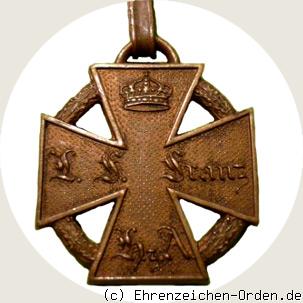 Obverse: Marching cross for 1813-1815.
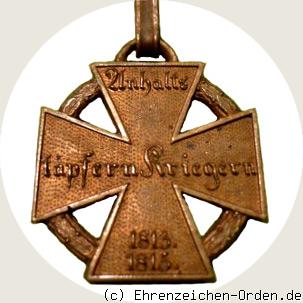 Reverse: Marching cross for 1813-1815.
Established:
February 5, 1823 by Duke Leopold IV.
Data:
- Material: Bronze
- Size: 28mm
- Weight: 14.6g
estimated collector price:
420 – 450 €

 Awards of World War II