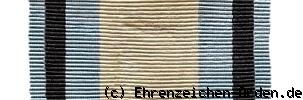
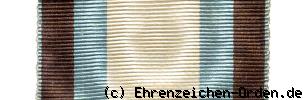
Awards of Germany - Military commemorative signs for 1813, 1814, 1815.
This badge of honor was established by King Maximilian Joseph I on December 4, 1814 for all soldiers who in 1813, 1814 and 1815 were included or even only included in the budget of the disbanded army and were included in the armed forces, but did not fight. Commander-in-Chief Field Marshal Prince Wrede, as the only soldier, received a gilded neck cross. Everyone else from general to soldier received this cross. Shortly after the first awards ceremony, doctors in the field were also included in the circle of eligible people. Veterinarians were excluded. The cross was not refundable, and was also awarded posthumously. In addition, all the banners of those regiments and battalions of mobile legions and the 3rd class national guard received a military memorial sign that did not belong to the armed army, but were ready to defend the border of the Fatherland.
According to the charter, the cross was without lacquered cross emblems and gilded writing and medallions. These are private reconstructions that were banned as early as 1817.
Bronze cross with rounded cross-shaped sleeves and smooth edges. Above is a leaky ear with a ribbon ring. Forder and reverse with round central shield. The inner sides of the cross sleeves are covered with black and green paint. The relief font, medallions and fields are gilded.
Front side:
- Bronze middle shield with a laurel wreath as the edge.
In - the closed middle part, on a radiation background, rough letters: - M - J -.
- On the cross sleeves: above - BEHIND - right - DIE - left - YEARS - below - 1813 - and - 1814 -
Downside:
- Bronze middle shield with a laurel wreath as the edge.
In - a surrounded field, on a diamond-shaped background, a crowned Bavarian lion walking to the left with a scepter and a sword.
- On the cross sleeves: above - KING - right - AND - left - FATHER - below - COUNTRY -.
Tape:
Volume 1 Officers and enlisted men: 35 mm wide, light blue edging 2 mm, side stripes black/light blue 3 mm/4 mm, white central stripes 15 mm.
Volume 2 Military ranks: 35 mm wide, light blue edges 1 mm, side stripes black/light blue 4.5 mm each.
Photos courtesy of "Münzgalerie-Frankfurter Allee"
10247 Berlin, Frankfurter Allee 106a
Contacts: muenzgalerie.gietzelt@gmx.de
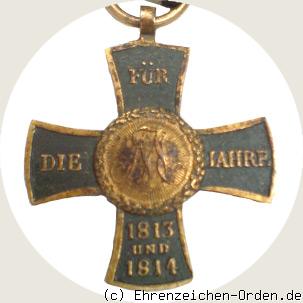 Obverse: Military memorials for 1813, 1814, 1815.
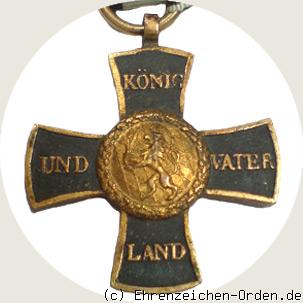 Reverse: military memorials for 1813, 1814, 1815
Established:
December 4, 1814 by King Maximilian Joseph I.
Data:
- Material: bronze partially painted
- Size: 32mm x 37.5mm
- Weight: About 11.8
estimated collector price:
90 – 110 €

 Awards of World War II