German Awards - Iron Cross 2nd Class 1870
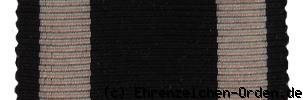
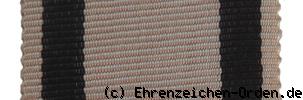
King William I established the Iron Cross on 19 July 1870. The fund was dated to the 60th anniversary of the death of his mother, Queen Louise. In the Iron Cross tradition of 1813, the statutes were widely retained. It was awarded to fighters on a black ribbon with white side stripes. Heaven was awarded a cross on a white ribbon with black side stripes. Patriotic actions at home were not rewarded with the Iron Cross. Knights of the Ioannites were also awarded a cross on a non-belligerent ribbon. The inheritance of the Iron Cross, as in 1813, fell away.
The renewal of the Iron Cross by William I during the Franco-German War consists of 3 classes of the Grand Cross, 1st class and 2nd class. For the Grand Cross, rewarding was considered for winning a decisive battle, for taking a significant fortress, or for a long defense of a fortress that did not fall into the hands of the enemy to the corresponding commander. No manufacturer's marks were applied to the band ring (as in 1914).
The cross consists of a silver 2-part coffin, which is soldered. The front and back sides of the coffin have a 2-step edge raised inside, from which the inner edge is shaded with a semicircular and small transverse stroke. Between them is an inner cross of blackened iron or cast iron (magnetic). On top is a single-soldered eye with a tape ring.
Gearboxes of 33 mm and 27 mm were also made.
Front side:
in the - center of the iron core, the letter - W -
in - upper cross sleeve Prussian royal crown
in - lower cross sleeve year - 1870 -
Downside:
- form of the first award of the cross of 1813
in the - center of the iron core 3 oak leaves with 2 acorns
in - the upper cruciform shoulder of the letter - F - W - under the Prussian royal crown
in - lower cross sleeve year - 1813 -
Tape:
- Fighters: black stripe 30 mm wide, edging 2 mm, white side stripes 5 mm.
- Non-combat: white ribbon 30 mm wide with black side stripes 5 mm wide
.
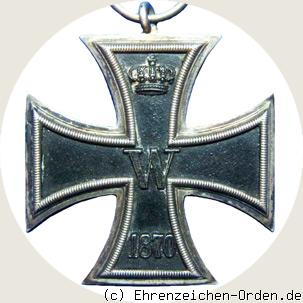 Front: Iron Cross 2nd Class 1870
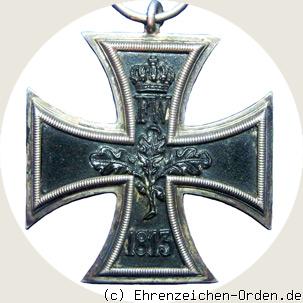 Reverse: Iron Cross 2.Class 1870
Established:
July 19, 1870 by King William I.
Data:
- Material: silver/iron
- Size: 41.9mm
- Weight: approx. 15.9g
estimated collector price:
400 – 430 €

 Awards of World War II