Awards of Germany - Iron Cross 1st Class 1870
The Iron Cross was first established by Frederick William III. It was established on March 10, 1813 for the liberation wars against Napoleon. The foundation was timed to coincide with Queen Louise's birthday. The Iron Cross had 3 classes: Grand Cross, 1st Class and 2nd Class. After France declared war in 1870, William I resumed the Iron Cross Foundation on 19 July 1870. The foundation, in turn, was dated to the 60th anniversary of the death of his mother Queen Louise. On the front side now in the center is the letter - W -, at the top is a crown, and at the bottom is the year - 1870 -. The reverse was adopted by the crosses in 1813. The classes and basic assignment rules have been saved. Thus, the cross was awarded without regard to rank and class. The award to the 1st grade assumed the former possession of the 2nd grade. A large cross was awarded to the commander only for winning a decisive battle, taking a fortress or defending a fortress. As for the carriers of 1813, honorary gold was to be paid. Approval of the payment dragged on until 1878. After that, a monthly honorary salary of 5 thalers for the 1st grade and 3 thalers for the 2nd grade was paid. A prerequisite was the possession of a military honorary badge of the 2nd class or an equivalent non-Russian award. Awards on a non-combat tape were made only sparingly. At the request of the king, patriotic achievements during the war were to be appreciated by other orders. Among them were the 3rd and 4th. The Order of the Crown with the Red Cross, the General Badge of Honor with the Red Cross and these awards on the ribbon of memory without the Red Cross. The Grand Cross was awarded only 9 times during the war of 1870-71. Iron Cross 1. The class has been awarded about 1,300 times. There are differences in needles. Round needles and flat, centrally expanded needles are known. In addition, some auxiliary devices for carrying or reinforcements are known, such as forks on the right and left.
The cross consists of a silver coffin and a silver back, which is soldered to it. The front part of the coffin has a raised, located inside, 2-step edge, from which the inner edge is shaded with a semicircular and small transverse stroke. The inner cross is made of blackened iron (magnetic). On the back is a vertical needle with reciprocal hooks. Additional side hooks are also known. The manufacturer's designation is on the back.
Front side:
In the - center of the iron core, the letter - W -
In the - upper cross sleeve Prussian royal crown
In - the lower cross sleeve year - 1870 -
Downside:
- Smooth with a vertical pin.
- The central 3-line manufacturer's designation is I. - WAGNER - & - S. -/- 14 -/- LÖTH: -
.
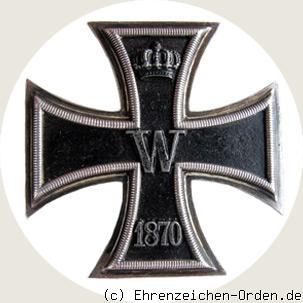 Face: Iron Cross 1.Class 1870
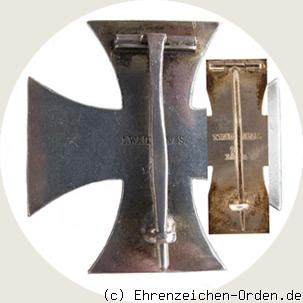 Reverse: Iron Cross 1.Class 1870
Established:
March 10, 1813 by King Frederick William III.
July 19, 1870 by King William I.
Data:
- Material: Silver, Iron Blackened
- Size: 42mm
- Weight: approx. 15.4g
estimated collector price:
2600 – 2800 €

 Awards of World War II