German Awards - Iron Cross 2nd Class 1813 for fighters
In the war of liberation against Napoleon's foreign domination, this probably unique award (in terms of fame and symbolism) was given on 10 March 1813 by King Frederick William III.
King Frederick William III wanted this award to give all brave soldiers (and not soldiers) an honorary sign that makes everyone equal, be it an officer or soldier. Of decisive importance was only courage and dedication in the struggle for freedom and independence. The iron cross was donated on Queen Louise's birthday.
As such, it was decided that only 2nd Class should be acquired before 1st Class was awarded, regardless of how many awards Jenige already had. A large cross was awarded only to commanders who won a decisive battle, captured a fortress or successfully defended a fortress.
Iron Cross consists of 3 classes: Grand Cross, 1 Class and 2 Class.
The cross consists of a silver 2-part coffin, which is soldered. The front and back sides of the coffin have a 2-step edge raised inside, from which the inner edge is shaded with a semicircular and small transverse stroke. Between them is an inner cross of darkened cast iron (magnetic). Characteristically, the core is stepped and higher, small holes or inclusions of material. Burst iron cores are not uncommon due to the tension of the material in the casting.
On top is a soldered eye with a ribbon ring.
Half-sizes of 33 mm and 27 mm were also made.
Front side:
- Smooth and blackened iron core.
Downside:
In the - center of the iron core there are 3 oak leaves with two acorns.
In the - upper cross sleeve are the letters - F - W - under the Prussian royal crown.
In the - lower cross sleeve year - 1813 -.
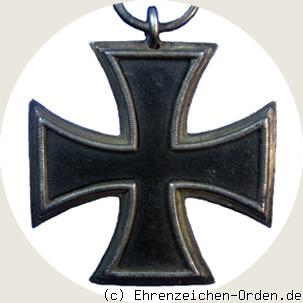 Obverse: Iron Cross 2nd Class 1813 for fighters
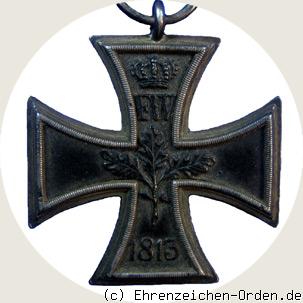 Reverse: Iron Cross 2nd Class 1813 for fighters
Established:
March 10, 1813 by King Frederick William III.
Data:
- Material: silver/cast iron
- Size: 38.8mm
- Weight: 18.5g
estimated collector price:
1900 – 2300 €

 Awards of World War II