German Awards - Iron Roland Bremen Civic Committee
The badge of honor "Iron Roland" was established by the Bremen Civil Committee on February 4, 1919. The Bremen Senate approved the fund on March 13, 1919. All participants in the liberation struggle against the Council of Workers' and Soldiers' Deputies on February 4, 1919 (the fund was backdated) had the right to receive. The condition for receipt was confirmation of the participation of the head of the unit, and later an entry in the book of monetary allowances. Consideration of applications and their presentation was undertaken by the Civil Committee. The presentation included a certificate with an assigned number.
On November 6, 1918, the rebellious sailors from Kiel arrived in Bremen. On November 7, 1918, they formed the Council of Workers' and Soldiers' Deputies. The latter seized power and dissolved the Bremen Senate and burghers on 14 November. The bourgeoisie and the liberal forces of Bremen organized the Bremen Civil Committee for resistance, chaired by shipowner Friedrich Adolf Finnen. On January 1, 1919, the 75th Infantry Regiment returned to Bremen. The officers entered into negotiations with the Council and demanded the re-establishment of the Senate. Radical communists demanded the arming of workers and had already begun to do so. The Workers' and Soldiers' Council (over 200 members) broke up and Bremen was in chaos. When the Council proclaimed the "Bremen Soviet Republic" on 10 January 1919, Gustav Noske, as minister of the new imperial government, ordered troops to be sent to Bremen. Colonel Wilhelm Gerstenberg assembled a rapid reaction force which arrived at Verdun on 29 January. The troops of the Reichswehr "Gerstenberg Division" joined with the volunteer corps formed by Major Walter Caspari, numbering about 600 people. Caspari was an officer in the 75th Infantry Regiment and a carrier of Pour le Merite. On January 30, regular negotiations with the Council took place, but they failed. On February 4, 1919, the attack and liberation of Bremen took place. The main part was taken over by Freikorps Caspari, part of the 3rd Airborne Defense Brigade and the 1st Marine Brigade under the command of Colonel von Roden. The fighting ended late in the evening.
The project of the badge of honor belongs to Professor Kleinhempel from Bremen. Various variants of the Iron Rolands were made, which vary somewhat in size and weight. Modern products are painted or whitewashed in iron. Needle systems are found in iron and non-ferrous metal. Products of the post-war period are made of non-ferrous metal with and without blackening/coloring. Famous manufacturers of modern products were: Gustav Adolf Müller, Bremen (manufacturer by embossing 3 lines on the back), Koch & Bergfeld, Bremen and A.W. Hering, Bremen. Post-war products were produced, in particular, by Steinhauer & Lück. The number of awards is estimated from approximately 2000 to 3000 due to the strength of the units. There are known applications for awarding until 1944.
Oval badge made of iron. It is black lacquered or dark brown. The back side is smooth with a perpendicular pin and counterhook.
Front side:
- The front side with a raised, rounded edge.
- In the center from the lower to the upper edge rises the image of the "Bremen Rolands."
In the - upper part on the left - ° - VRYHEIT - DO -, on the right - IK - JU - OPENBAR - ° -.
- Down the edge on the left is BREMEN -, to the right of Roland - 1919 -.
Downside:
- Smooth with a vertical pin with a mating hook.
- (If this is the central 3-line print with the manufacturer).
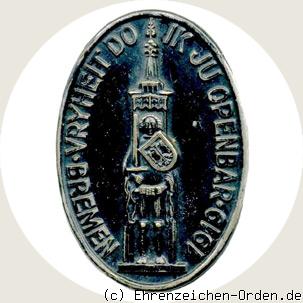 Iron Roland of the Bremen Civic Committee
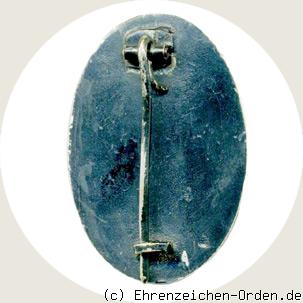 Reverse: Iron Roland of the Bremen Civic Committee
Established:
February 4, 1919 Bremen Civic Committee/Senate
Data:
- Material: iron blackened
- Size: 44.8mm x 30.15mm
- Weight: 16.7g
estimated collector price:
180 - 200 € with manufacturer
130 - 140 € without manufacturer

 Awards of World War II