German Awards - Grand Cross/Cross with Swords 2. Form
Large crosses or lumber crosses with swords of the 2nd form were made mainly of silver with gilding. Gold copies could only be awarded for wars before 1902. First World War crosses are usually gilded with silver. It is possible to distinguish large crosses from comture ones only by the corresponding thoracic stars, or a large cross with an 8-ray star, or comture 1. 4-beam star class. Commander crosses were also worn in the form of neck orders and large crosses on the sash. 2nd class Komtur was awarded without a breast star.
The order was created by King Frederick Augustus II. It was presented to Duke Albrecht on December 31, 1850. Originally divided into the following classes: Grand Cross, Komtur 1. Breast Star Class, Comtur 2. Class, knight and small cross (since 1858 an honorary cross). The award took place by decree signed by the king. The order was subject to return in case of promotion or death of the awarded. Order crosses were awarded in 2 forms. The 1st form until 1875 was slightly smaller and made of gold. Another distinguishing feature is the so-called bun hat in the medallion. The 2nd form depicted here, with the correct portrait of Albrecht, was made with a gold medallion of several parts (from 1876 to 1902). After that, gilded in silver was made out of cost savings. It was produced by G.A. Scharffenberg. On March 26, 1861, Albrecht's gold and silver medal was added to the order. The foundation of swords occurred in 1866. Other extensions included dividing the Knights into the 1st and 2nd. class 1876, 1883 star to the Grand Cross in Gold, the base of the Officers' Cross 1890 and the Golden Crown to the Knight's Cross 1st Class to name the most important extensions. A large cross with swords was awarded 660 times. Crosses in gold, mostly large crosses, were granted only about 110 pieces.
An elongated cross made of gold or gilded silver with white enameled cross sleeves. Front and rear with a superimposed round medallion. Between the cruciform sleeves at a short distance is a green enameled oak-leafy wreath. A gold crown is movably fixed on the upper cruciform shoulder. 2 crossed silver gilded swords embossed on one side pass through the center, which are superimposed and rise above the oak leafy wreath on the front side. A small ring with an elongated ribbon ring passes through the imperial crown apple.
Front side:
- A circular central shield on the outside with a broad blue enamelled ring in gold with a gold curved inscription:
- - ALBERTUS - ANIMOSUS -
At the - bottom of the ring is a six-pointed star, jewelry on the left and right
In the - center, on a white enameled background, the gilded Potrait Albrecht Host
Downside:
- Round central shield outside with wide blue enamelled gold ring with gold embellishments
- Bottom number of the year - 1850 -
In the - center on a white enameled background under the gilded Saxon royal crown coat of arms of Saxony
- Stripes black enameled alternating gilded, obliquely set crown green
Tape:
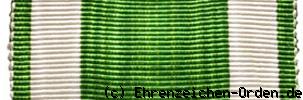
Neck cross 56 mm wide, green edges, white side stripes of 9 mm.
.
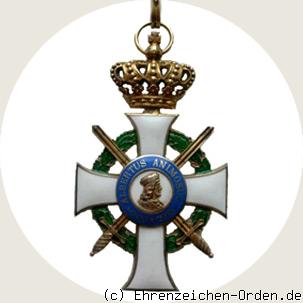 Obverse: Order of Albrecht Grand Cross/Comtour Cross with Swords 2. Form
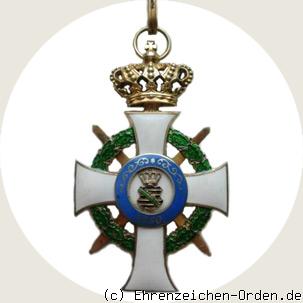 Reverse: Order of Albrecht Grand Cross/Comtour Cross with Swords 2. Form
Established:
December 31, 1850 by King Frederick Augustus II.
Data:
- Material: silver gilded/enameled
- Size: about 91.5 x 54mm
- Weight: about 47.5g
estimated collector price:
No data in gold
2000 - 2200 € silver-gilded

 Awards of World War II