Awards of Germany - Reichsbund of German railway workers participating in the war Honorary Cross of the 2nd class
This badge of honor was established around 1922 by the Imperial Union of German Railway Workers participating in the 1914/1918 war. It is also referred to as the Federal and Military Commemorative 2nd Class. I don't know anything about the exact rules of awarding. The Confederation established a cross in 3rd grade. 1st grade is a neck cross with blue enameled cross-shaped sleeves and a nasal decanter in the form of a green enameled oak leafy wreath. The 1st grade with the inscription - FOR MERIT - was intended, perhaps, only for a few honorary members. Shown here 2. The class was awarded probably to particularly distinguished members of the Union. 3rd grade - a silver badge of honor without enamel. In addition, the Confederation established honorary ranks in gold and silver, as well as membership ranks in gold and silver. The first form of the cross of honor was enameled blue without an eagle between the cross sleeves.
The Imperial Union was founded on May 25, 1919 by Chairman V. Severin as the Union of German Field Railway Workers participating in the war. The renaming to the Imperial Union of German Railway Workers participating in the 1914/1918 war took place around 1922. The headquarters was in Berlin, W 57, Bülowstr.85. The association's magazine was called "German Signal." In 1925, the union had about 15 thousand members. Bund's protector was Field Marshal von Hindenburg. Among the 20 honorary members (as of 1925) were Field Marshal von Mackensen, Minister of State von Breitenbach, and many dignitaries and military men. In late 1925, the Imperial Union ran into financial difficulties and there was a threat of dissolution, which probably occurred in 1926/27. The reason for this was inflation and non-payment of contributions, as well as the miscalculation of the club sheet. Due to several years of awards, insignia are quite rare and expensive. The exact dates of the award are unknown to me .
A pointed cross made of white metal. The cross on the front is enameled white and burgundy gold. Between the cross sleeves are black enameled, gold bordered eagles. In the center is a riveted round central shield. The reverse is smooth and silver with a perpendicular pin with an opposite hook.
Front side:
- White enameled cruciform arms with a wide gilded border.
- Distributed on cross sleeves in gold from above: the winged wheel of the railway.
- Among them are the letters - R.- B.- (for Reichsbund).
- On the left cross number of the year - 1914 - on the right - 1918 -.
- On the lower cross sleeve are the letters - D.-K.- (German railway worker participating in the war).
- Laid round medallion with raised, rounded, gilded border.
- It has 12 golden oak deciduous leaves. The enclosed field is enameled in white.
- 1914 Iron Cross image. A silver inscription is curved along the edge:
- Top - B - TRUE -, bottom - PARTNERSHIP - divided by 2 points.
Downside:
- Smooth and silver. Vertically - a pin with a reciprocal hook. (Needle jack repaired)
Center - 2 rivets to see from medallion. To the left of the rivet is deepened - GES.- To the right of the 2nd rivet - GES.-.
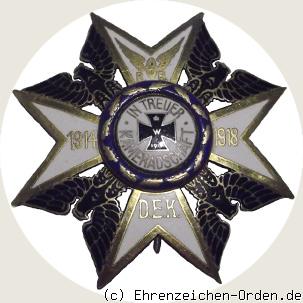 Front: Imperial Union of German Railway War Veterans 2nd Class Cross of Honour
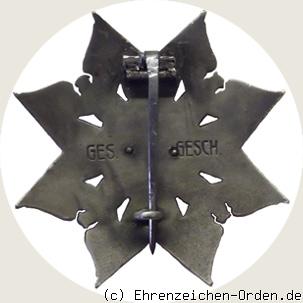 Reverse: Imperial Union of German Railway Workers Participating in the War 2nd Class Cross of Honor
Established:
1922 - Reichsbund of German railway workers participating in the war
Data:
- Material: white metal with gilding, enamel
- Size: 48.3mm x 47.5mm
- Weight: 21.8g
estimated collector price:
160 – 180 €

 Awards of World War II