German Awards - Medal of Merit in Silver
This medal was instituted in 1934 following the abolition of the Federal Merit Cross under the National Socialists Act 1934. Whether this needle is now a merit needle or a penis needle is not entirely clear. A 2006 article by J. Nimmergut in Orden und Ehrenzeichen, Magazin der DGO, No. 46 referred to as a membership needle. In the book "Insignia and Awards of the German Warrior Clubs of 1800-1943" also from Nemmergut, he is listed as a medal for merit in silver. This is also supported by the fact that gold has a needle of merit and a needle of merit with a laurel wreath. In addition, there is also a round federal service sign with a laurel wreath. The union was founded on June 16, 1905 in Essen. The illustrious Field Marshal von Heseler is named after him. The Prussian officer was highly regarded for his impeccable career and virtues. The goal was to unite the unions of soldiers of the XV, XVI centuries. and XXI. Unite the corps of the old army. At the 38th meeting of the Bundestag in Hohenlimburg on the occasion of the 25th anniversary of the founding of the Confederation, the Confederate Cross of Merit was established in three stages. The union consisted of about 150 partnerships or unions with about 10,000 members. Source: J. Nemmergut, Order and Badge of Honor, DGO Journal, No. 46, 2006., Nemmergut, badges and awards of German warrior clubs 1800-1943, 2012.
A silver-plated diamond-shaped pin. The bottom is completed with a pointed, enameled shield. On the back is a pin dissolved with plates.
Front side:
- The edge of the rhombus is raised and graduated 3 times in the upper region.
In - a confined space, a portrait of Field Marshal von Heiseler.
- The lower pointed shield on top with written beams. On it in black - HAESELERBUND -.
- The lower part of the shield is silver side and multi-colored enameled.
- The central part is yellow with a black iron cross in the center.
On - the sides are two stripes of orange and green, bordered by silver laurel.
Downside:
- A long corrugated pin is soldered with the help of plates.
- At the bottom of the plate is GES.GES.-.
.
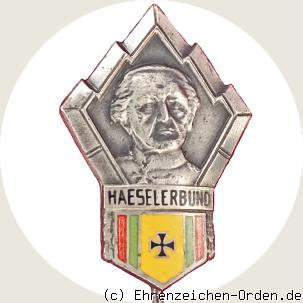 Front side: Gaeselerbund, silver needle
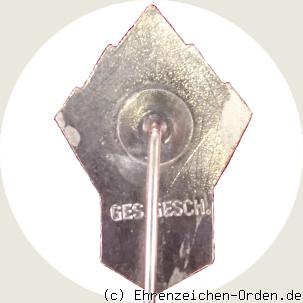 Reverse: Silver Checkmark
Established:
1934 in the Heiseler Union
Data:
- Material: silver-plated copper alloy, enamel
- Size: 28.8mm x 19.5mm
- Weight: 4.5g
estimated collector price:
40 – 50 €

 Awards of World War II