Germany Awards - Baltic Cross Trainspotting
The Baltic Cross was established by the Baltic National Committee in 1919. The National Committee was the political representation of the German population in Courland and Livonia. The Baltic Cross was a military decoration for all soldiers, starting with the officer, who fought in the area for at least 3 months in 1919. The purpose of this unit was to defend the territory of Germany from the advancing Russian troops after the First World War. After refusing to submit, the Baltic troops were defeated in November 1919.
This award was recognized as a state award in 3 Reich and later in the Federal Republic, and could be worn. In total, about 22 thousand crosses were awarded. The method of wearing on the tape was intended only for the order buckle and thus was not awarded. The tape was worn in a buttonhole. The assumption that the cross on the ribbon was 2nd class is incorrect. Crosses were produced and distributed by various manufacturers until the 1930s. These included Meybauer, Godet, Petz & Lorenz. Needle designs were most common, with screw disc crosses with various nuts also occurring. Materials also range from blackened iron with a colored metal cross applied to pieces of solid non-ferrous metal. Half-sizes and miniatures were also offered for sale.
A straight cross made of non-ferrous metal in the form of a cross of the Teutonic Knight's Order. At the back is a vertical pin.
Front side:
- The straight bottom cross of non-ferrous metal is blackened .
- Cross with lilies at the ends of brass.
- The upper cross is fixed with pins or rivets through the lower cross.
Downside:
- Smooth with a vertical pin. See rivets or pins.
Photos of www.militaria-berlin.de
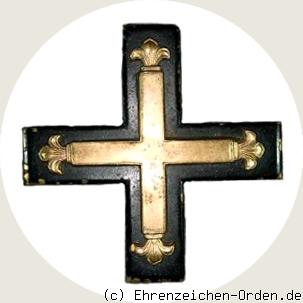 Front side: Baltic cross on the needle
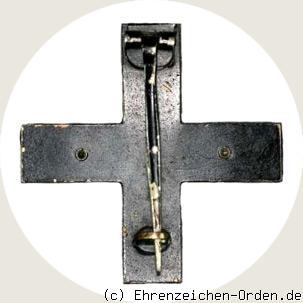 Reverse: Baltic Cross on the Needle
Established:
1919 Baltic National Committee
Data:
- Material: non-ferrous metal/partly black
- Size: approx. 45.3 mm
- Weight: about 11.3g
estimated collector price:
80 – 100 €

 Awards of World War II