German Awards - Post-1933 Police Mountain Guide Badge
The Polizei-Bergführer sign was introduced in this form after the seizure of power by the National Socialists. With the development and use of mountainous areas at the end of the 19th century, the need and the need to create trained personnel who know the area increased. In addition to tourism, appropriate personnel were also required for the military and police. The difference from mountain leaders in civilian life was that military or police mountain leaders were hired civil servants and had the corresponding ranks. I do not know anything about the exact rules of training. However, it can be assumed that in addition to mountaineering knowledge and skills, in summer, as in winter, it was necessary to undergo police training. After successful qualification, he was awarded a service badge. Mountain guides in the service of the police must have been extremely rare and, accordingly, service badges too. (The Federal Republic of Germany has only 39 police mountain guides for the entire German Alpine region.) Towards the end of World War II, the police and auxiliary police were placed under the command of the Wehrmacht. The army had for formations stationed in the mountains its own commanders with similar or similar training. Currently, police mountain guides are organized both at the national level, in the German Association of Police Mountain Guides, and at the European level in the European Association of Police Mountain Guides. Other national associations exist in Austria and Switzerland.
High oval sign made of silver-plated non-ferrous metal. The front side is enameled and with a silver-plated separate edition. The back side is smooth, silver-plated with a perpendicular pin.
Front side:
- The rim is formed from a wide descriptive ring, borderline silver in color inside and out.
- Ring with green transparent enamel. Translucent small puncture.
- On the ring there is a silver inscription: on the left - the police, at the top - the mountain, on the right - the leader.
- Locked midfield in white enamel. It has a separately made, silver circulation.
- It consists of the main eagle of the police (an eagle with outstretched wings on an oval wreath,
in - catch an oak wreath with a swastika placed on top.)
- Under it, 2 alpine white flowers are located nearby. The middle consists of 7 gold points.
- Flowers of 10 curved petals.
- The tips of the eagle's wings and petals are superimposed on the ring above and below, respectively.
Downside:
- Smooth and silver-plated with a vertical round pin with a mating hook.
In the - center from the top 1 and from the bottom on the side 2 rivets with which the support is attached.
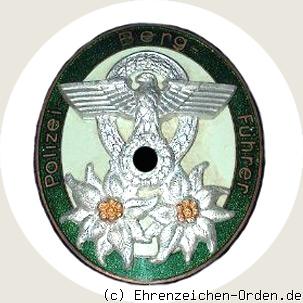 Front side: "Polizei-Bergführer" breastplate after 1933
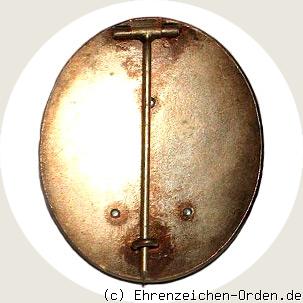 Reverse: Post-1933 Police Mountain Guide Badge
Established:
introduced after 1933
Data:
- Material: non-ferrous silver-plated metal, enamel
- Size: 52mm x 44.1mm
- Weight: 29.3g
estimated collector price:
3200 – 3600 €

 Awards of World War II