German Awards - German Youth Rider Badge
The German Youth Rider badge was established on August 7, 1932 by the Imperial Union for Breeding and Testing German Warm-blooded Animals. The reason was the Second Imperial meeting of German equestrian youth. Officially, the badge was recognized as a sports honorary badge only at the end of 1935. Young people under 18 who passed the corresponding exam were awarded. The exam included dressage exercises (3 gears), jumping exercises (a total of 8 jumps and 3 different obstacles). Only one class was spent on the badge. The badge was to be a motivation and equestrian award to inspire young men to cavalry. Due to the great popularity of the sign, about 11,000 copies were awarded until 1942. Notable manufacturers were Chr. Lauer, Nürnberg, W. Annetsberger, München and Steinhauer & Luck of Lüdenscheid. They were made of bronze and zinc. For pieces of zinc behind in the wreath inscription: - GES.- GES.- REICHSVBD.- F.- Z.- u.- PR.- D.- WARMBL. - (plus manufacturer).
Round, hollow embossed sign made of tinted bronze. At the back is a horizontal pin that is soldered using pPlatten. With the manufacturer's number, it's under the rider's foot.
Front side:
- The edge is formed from a laurel wreath.
- At the bottom of the wreath inside the belt laid to the circle, the letter is R -.
- Central, depicting a horse galloping to the left.
- The hind limbs rest below on a round belt. The front is tilted in mid-air.
- A rider sits on a horse. The rider's head and horses touch the edge .
- The horse's tail goes all the way to the edge.
Downside:
- Hollow embossed. In the center is a broken record with a horizontal pin.
- (without manufacturer number)
Photos of www.militaria-berlin.de
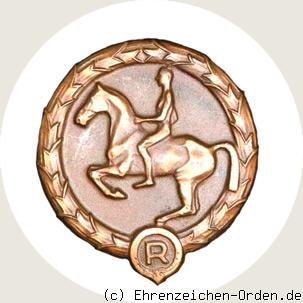 Front: German youth rider's breastplate
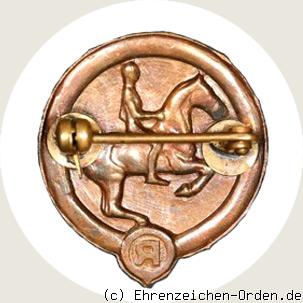 Reverse: Sign of the German youth rider
Established:
On August 7, 1932, the Imperial Union for Breeding and Testing German Warm-blooded e. V.
Data:
- Material: Bronze tinted
- Size: 31mm x 34mm
- Weight: 8.3g
estimated collector price:
150 - 170 € in bronze
110 - 130 € in zinc

 Awards of World War II