German Awards - German Equestrian Badge 3. Bronze class 1930
The establishment of equestrian clubs dates back to the end of World War I. At the regional level, many equestrian communities have been established. Equestrian sports, such as jumping, walking on railings, etc., were usually practiced only by military personnel before the First World War. All participants in the Olympic equestrian games belonged to the military.
In 1905, the Union of Half-Breeders was founded in Berlin (since 1910 - the Union of German Half-Breeds). Since 1910, there were already uniform rules for conducting material, qualification and operational tests. The findings were published in the yearbook. In the 1920s, with the growing popularity, more and more civilians began to engage in equestrian sports.
The badge of the German cavalry was established on April 9, 1930 by the Imperial Union for breeding and testing German warm blood in this form. Various badges have been instituted as motivation and badges for acquired qualifications and achievements. These included rider insignia, driver insignia, and youth rider insignia. This, like the rider badge presented here, in 3 stages. It is divided into 3 classes of gold, silver and bronze. While 3rd and 2nd grades can be obtained by confirming qualifications and skills, 1st grade in gold was only awarded after sporting victories in the riding discipline. By the end of the war, the signs were made of military metal (zinc).
The equestrian badge is awarded to this day in a modified form. The requirements for individual classes have not changed significantly and can be requested from the Equestrian Union.
High oval, openwork work mark made of bronze. On the back is a vertical pin. The manufacturer lifts along the edge of the back.
Front side:
- The edge is formed by an oak-broad-leaved wreath.
- At the bottom of the wreath inside the belt laid to the circle, the letter is R -.
- Above the belt is a horizontal line or pedestal on which the horse's rear hooves stand.
- Central, pierced the image of a horse galloping to the left.
- The hind limbs rest on the edge from below. The front is tilted in mid-air.
- A rider sits on a horse. The horse's head and tail go all the way to the edge.
Downside:
- The reverse is half naked with a vertical flat pin.
- To the left of the edge, the font increases: - LEGAL - PROTECTED -.
- To the right of the manufacturers is L. - CHR.- LAUER - NÜRNBERG - - BERLIN -.
Photos of www.militaria-berlin.de
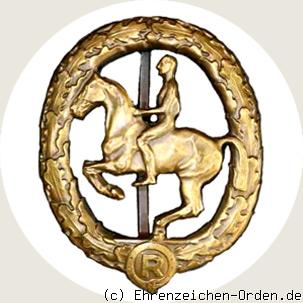 Obverse: German equestrian mark 3. Bronze class 1930
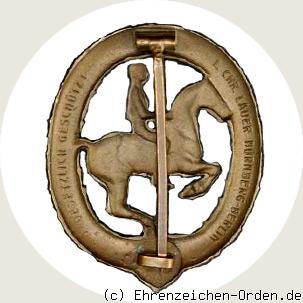 Reverse: German equestrian mark 3. Bronze class 1930
Established:
April 9, 1930 by the Imperial Union for breeding and testing German warm-blooded e. V.
Data:
- Material: Bronze
- Size: approx. 52.7 mm x 42.7 mm
- Weight: about 14g
estimated collector price:
70 – 90 €

 Awards of World War II