German Awards - German Youth Bronze Insignia
The bronze execution mark depicted here is dark patinated. Unlike other insignia, they show neither the manufacturer's RZM number nor the assigned number. The second parts have a large letter B as an identifier. In 1935, a version with a blackened or dark tint was also released. Perhaps this is a very early piece without marking. The Deutscher Jungvolks insignia was established on October 3, 1935 by Reichsführer Baldur von Schirach. The German youths were between 12 and 14 years old. They were called "peaks." The goal was to give the German Jungwolf a single worldview and physical training. The sign was supposed to be a partnership sign, and could also be obtained only by serious work in the community. Executive regulations were adopted by the Office of Physical Training. The test was then also called the "pimpfen sample." Prerequisites for receiving the Badge of Achievement were worldview training, physical exercises, travel and camp (tent camp for at least 3 days) and targeted exercises. Passing exams took place on State Youth Day or in large summer camps. The conditions of the exams changed several times, and in 1941 the item "passage and camp" was replaced by "military training." The award was made by the Reichsjugendführer. In 1944, Reichsügendführer Axman ordered the award to stop. The sign was made of various materials. Thin zinc, light metal, and machine embroidery are known. Notable manufacturers were Gebr. Hahne, Lüdenscheid M1/12, Ferdinand Hoffstetter, Bonn M1/15, Steinhauer & Luck, Lüdenscheid M1/63 и Wilhelm Deumer, Lüdenscheid M1/120. Source: J. Nimmergut, Deutsche Orden und Ehrenzeichen before 1945, vol. IV, 2001.
Openwork work sign in the form of a standing victory rune with a superimposed round middle part. Back side with vertical pin.
Front side:
- The circular central portion enlarges with a broad font ring.
In the - openwork middle part is a swastika placed on top.
- The margins between the crosses are shaded.
- On the ring is the inscription: - FOR - ACHIEVEMENTS - IM - D.J. -.
- The font is runic. It's - D.J. - down in reverse.
Downside:
In the - center with the plate dissolves the pin.
- There is no manufacturer marking and award number.
Photos of www.Militaria-Berlin.de
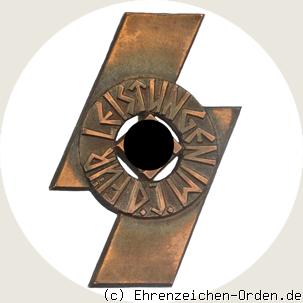 Face: "Deutscher Jungvolks" breastplate in bronze
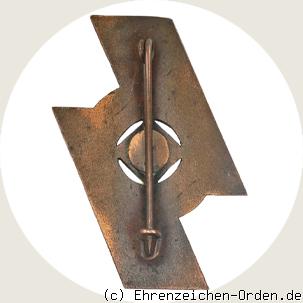 Reverse: Insignia of German youth in bronze
Established:
October 3, 1935 Reichsügendführer von Schirach
Data:
- Material: copper alloy bronze color/tinted
- Size: 47mm x 23mm
- Weight: 14, 8g
estimated collector price:
150 – 170 €

 Awards of World War II