German Awards - Civil Merit Medal 1815
The Civil Merit Medal was established in 1827 by Duke Charles II. accepted. He entered the Duchy government in 1823 and assumed full rule in 1826. Charles II. was the son of Duke Frederick William, who came to legendary fame as the "Black Duke." In the war with Napoleon, he died on June 16, 1815 at Katrebras. The medal was intended to recognize special "civilian virtues" in the military of 1815.
For the minor Karl (born in 1804) was succeeded by the future king George IV. Great Britain and Hanover, in London guardianship and government affairs. Friedrich V. A. von Linsingen was appointed his tutor. After taking office, serious clashes began with George IV. Charles II. refused to fully comply with the adopted decrees and government decrees. The dispute in the house of Britannia-Hanover ended before the Bundestag of the German Union in Frankfurt and was settled only in 1830 by the recall of Karl. The refusal to approve a new landscape order and the luxury of the duke led on September 7, 1830 to an uprising in Braunschweig, during which the castle burned down. On 2 December 1830, only temporarily, his brother William took over the administration of the duchy. Karl lived in exile until 1873.
Due to the short reign of Charles II. (1826-1830) very few medals were awarded. Some sources indicate only 3 awards. The embossing of the medal should be slightly higher. The picture shows a bronze section of the original. Medallions were made of both silver and bronze. The stamp was made by Leclerc Medallier in Ghent.
Round medal made of silver with an enlarged, stepped border. A parallel eye is knocked out from above. A small ring with a band ring passes through them.
Front side:
In the - center is a large portrait of Karl with curly hair.
- On the edge on the left is the inscription: - CARL - ° - HERZOG - ZU -, on the right along the edge:
- - BRAUNSCHWEIG - ° -. Under the cervical region is small: - LEVEQUE. ED. –
Downside:
- On the edge open from above, tied at the bottom with a ribbon, a light wreath of laurel with fruits.
- The included field increases the 4-line font: - FOR -/- CIVIL -/- MERIT -/1815 -.
- Below it is a horizontal line. Above the capital letter, additional i or ü strokes.
The drawing depicts a ruthless bronze dump!
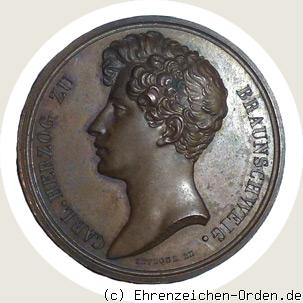 Front: 1815 Civil Merit Medal
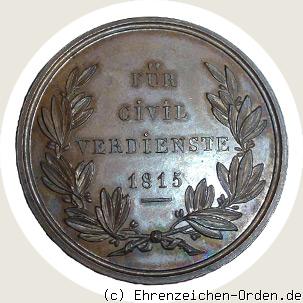 Reverse: Civil Merit Medal 1815
Established:
circa 1827 by Duke Charles II.
Data:
- Material: Silver
- Size: 33mm
- Weight: 17g?
estimated collector price:
Unspecified

 Awards of World War II