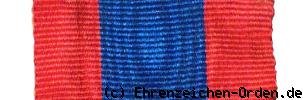
German Awards - Honorary Civilian Cross 2. Class (senior line)
The honorary civil cross was instituted by Prince Henry XX. On 15 September 1858, the senior line was divided into 2 classes. The 1st class was a hollow manufactured gold cross, the 2nd class was a massive silver cross. The middle signs for both classes were gold and enameled. Men in court, state and municipal service were awarded, who for a long time earned loyalty to their subjects and service on their profession, and also demonstrated their devotion to the princely house. Persons in church, school and communal services, after many years and special merits, could also be awarded the cross as an exception. A special number of years of service was not a prerequisite for the award. The 1st Class Honorary Civil Cross was to be awarded only to those in a higher court position. Prince Henry XXII. expanded the Civil Cross of Honor with the position of 29.05.1886 and 10.02.1890 to the 3rd grade in 2 departments. Late crosses of all classes had scalloped cruciform arms. Class 3 middle signs 1. the department had a green enameled wreath with a silver inner field and a gold inscription. 2nd detachment of the 3rd class entirely of silver. Late crosses of the 1st class were made of solid, gilded silver. In 1893, the Civilian Cross of Honour was renamed the Cross of Merit. 3rd Grade 2. Branch 1902 was abolished, but 16.12.1912 as low as 4. Class returned unchanged. Source: J. Nimmergut, Deutsche Orden und Ehrenzeichen bis 1945, vol. II, 1997.
Silver cross with curly cross sleeves. Ends of crosses are bent inwards. The edges are shaded. The inner sides are smooth. Front and back with soldered gold middle shields (15 mm). On the upper cruciform shoulder is a pupate ear with a ribbon ring.
Front side:
- The edge of the middle shield consists of a green enameled wide oak-leaf wreath.
- In the included field on a white enameled background, 3-line gold font:
- - For -/- fidelity -/- services -.
Downside:
- The edge of the middle shield consists of a green enameled wide oak-leaf wreath.
- In the included field on a white enameled background, 2-line gold font:
- reflects the double trait of the name - F - R -, under it - X - X -. For Prince Royce 20.
Tape:
- Width 35 mm, side stripes red 10 mm each, central stripes blue 15 mm.
.
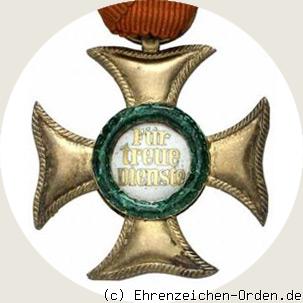 Front side: Civil Honorary Cross 2. Class (senior line
)
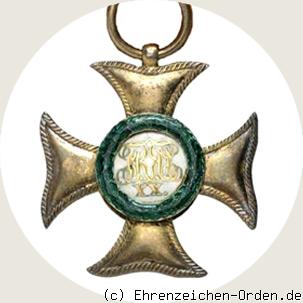 Reverse: Civilian Cross of Honor 2. Class (senior line)
Established:
September 15, 1858 by Prince Henry XX. Royce Senior Line
Data:
- Material: silver, gold, enamel
- Size: 30mm
- Weight: about 12g
estimated collector price:
500 – 530 €

 Awards of World War II