German Awards - Science and Arts Merit Cross 2. That is sick
The Cross for Merit in the Field of Science and Art was established on May 23, 1885 by Prince Henry XIV. A junior line was created. It was awarded in the 2nd grade with gold (gilded silver) and silver. The award was created specifically to recognize special services and excellent achievements in science and art. Both Russian citizens and foreigners were awarded. The design of the crosses was by Bury and Leonard of Hanau. In 1909, gold and silver medals were added. The Cross of Merit was extended to both principalities in 1912. There are crosses silver-plated from non-ferrous metal. They are slightly larger than 34.5 mm. The exact dates of the award are unknown to me. Source: J. Nimmergut, Deutsche Orden und Ehrenzeichen bis 1945, vol. II, 1997.
Silver cross. The edges of the crosses are smooth and polished. The insides are finely indented. Front and back with embossed round central screen. At a short distance from the medallion there is one, on the front side, green enameled, tied with a bow at the bottom, an open laurel wreath on top. It runs on the front side behind the horizontal wishbones and overlaps the upper and lower wishbones. On the reverse side, the wreath is superimposed on horizontal cross-shaped sleeves. On the upper cruciform shoulder, a parallel eye is soldered, through which an elongated ribbon ring passes.
Front side:
- On horizontal cross sleeves, Latin, raised, polished font:
- Left - Literis - et - and right - Artibus -. (Science and Art
) - The round median shield has a smooth, inwardly graduated, raised border.
In a - smooth field surrounded by a figured coat of arms of both principalities Reuss.
- He has a big crown.
- On the lower cruciform shoulder is a loop, stem and the first enameled leaves of a wreath.
- On the upper cruciform shoulder, 3 enameled sheets protrude across the edge.
Downside:
- Horizontal crosses are superimposed with a laurel wreath. This one is not enameled.
- The round median shield has a smooth, inwardly graduated, raised border.
In - a closed, smooth field, a large, decorated letter - H - is exceeded by a crown.
Tape:
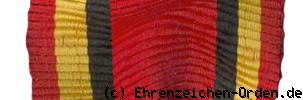
- red 25 mm wide, side stripes red/yellow/black 2 mm each.
.
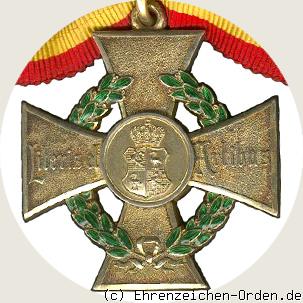 Obverse: Science and Arts Merit Cross 2. That is sick
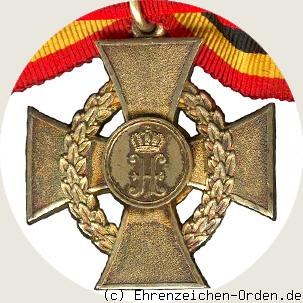 Reverse: Science and Arts Merit Cross 2. That is sick
Established:
May 23, 1885 by Prince Henry XIV. The younger line of Royce
Data:
- Material: silver, enamel
- Size: 33mm
- Weight: about 9.7g
estimated collector price:
570 - 600 € in silver
500 - 530 € silver plated

 Awards of World War II