German Awards - William Cross Without Swords for Military Merit
The William Cross was established on September 13, 1915 by King William II. It was originally intended for services to persons in the homeland and public welfare who could not be awarded the Iron Cross, then it was also awarded to servicemen with and without swords for military merits. The cross on the ribbon as the first step, and as the highest award - a cross-pin with swords and a crown. On these crosses for military merits on the reverse in the medallion there is an inscription - Military merit -. If the merit was not directly related to the war, then on the medallion of the reverse side there is no inscription - Military merit. Swords were awarded to servicemen for front-line use without swords with the inscription "Military merit without direct front-line use."
William's Cross was to serve as the equivalent of the Iron Cross, especially for services to the homeland. Awarding military personnel in the war with the Order of Military Merit or the Order of Frederick would reduce the importance of awards and should have been made only for exceptional services. Rewarding with a crown and swords suggested former possession of the cross on the ribbon. The cross was not refundable. The number of awards of the William Cross without swords and for public welfare is about 1950 pieces.
Dark oxidized bronze cross. Smooth-edged crosses rounded at the ends. The insides are finely indented. Front and back sides with engraved round medallion. On the upper cruciform shoulder is a soldered ordinary ear with a flat ribbon ring.
Front side:
- The central shield is surrounded by an oak-leafy wreath, which is tied with a cross above and below.
In - a closed field, the letter - W - is in Gothic font.
- On the lower cross sleeve number of the year - 1915 -.
- On the upper cruciform shoulder is a crown.
Downside:
- The central shield is surrounded by an oak-leafy wreath, tied with a cross above and below.
- The inscription enclosed in it is a finely divided field - KRIEGS -/- MERIT -.
Tape:
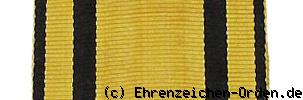
yellow 35 mm, black edges 2 mm, side stripes yellow/black 4 mm/3 mm.
.
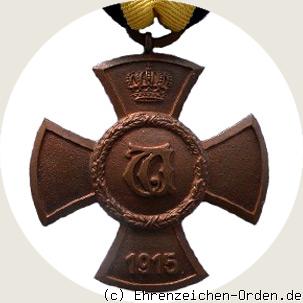 Wilhelmskreuz without swords for military merit
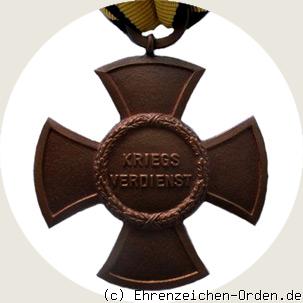 Reverse: William's Cross Without Swords for Military Merit
Established:
September 13, 1915 by King William II.
Data:
- Material: oxide. Bronze
- Size: 42mm
- Weight: 25g
estimated collector price:
90 - 110 € in bronze
80 - 90 € zinc bronzed

 Awards of World War II