German Awards - Order of Merit Chest Star to Comtur Cross with Swords
The chest star presented here belongs to the 1st class comture with swords. In this form, it was awarded silver gilded circulations only during the First World War. The first form of thoracic stars had significantly shortened, graduated rays between 4 main rays. Awards by the 1st class commander with a chest star are very rare. There are also stars with longer swords protruding above the rays. Only 15 awards received during the 1st World War are known.
The Order of Merit was established by King Frederick Augustus back in 1815 as a civil order of merit. Initially, the order was divided into 3 classes: the Grand Cross, Komtur and the Knight's Cross. Unofficially, the Civil Medal was considered the 4th class. In 1849, the order was renamed the Order of Merit and expanded to 5 classes. These included the Grand Cross, Komturkreuz 1st Class, Komturkreuz 2nd Class, Knight's Cross and Small Cross. For this, he received gold and silver medals. Foreigners were awarded the order with a different inscription on the reverse. (For merit) In 1858, the Small Cross was renamed the Honorary Cross. Swords for military merit were instituted for all classes in 1866. The swords on the ring were presented by King Johann only in 1870 for holders of the "Mir" class cross, who subsequently received military merit or for those who received a higher class but previously had lower-class military decoration. In 1876, there was a change in statutes. The knight's cross was divided into the 1st and 2nd. The class is divided. The honorary cross was no longer awarded and could be exchanged for the Knight's Cross of the 2nd class. For the gold medal "For Merit," the cross "For Merit" was established. An exchange was also possible. The new 6 classes were: Big Cross, Komtur 1st and 2nd. Class, 1st and 2nd class knights. Class and Merit Cross. In 1891, as a final extension, the golden crown was given to the Grand Cross and Comtur. Source: J. Nimmergut, Deutsche Orden und Ehrenzeichen bis 1945, vol. III, 1999.
Four-beam star made of silver. Between 4 main beams there are 7 intermediate beams, which are evenly distributed. All rays have lateral linear frames. On the front side there is a hanging round gilded and enameled medallion with crossed swords behind it. The reverse is smooth silver with the manufacturer's round jewelry plate in the center. Vertically - a pin with a reciprocal hook.
Front side:
- Gold-plated medallion with enlarged gold border. She's wearing a pearl cord.
- Subsequently, a wide, white enameled ring, bounded inside by a rim.
- A golden burgundy, green enameled oak wreath rises on it.
- This fruit, covered with red enamel, is pressed down below.
- The inner edge is raised with the circulation of the pearl cord.
- The included midfield is enameled in white with 4-line gold font:
- (less) - FOR -/- MERIT -/( less) - AND -/- FIDELITY
-. - Behind the medallion are crossed 2 antique, gilded swords with Roman paired poles.
Downside:
- Smooth with a vertical pin with a mating hook. In the center is a decoration.
- This one with a raised edge has 2 ring fonts. Outside more than inside.
- External style: above - G.- A.- SCHARFFENBERG - below separated by 2 6-beam stars: - DRESDEN -. -.
- Internal style: - GOLDEN WORKER - F.-K.- S.- ORDER: - at the bottom is a six-pointed star.
In the - center is a large royal Saxon coat of arms.
.
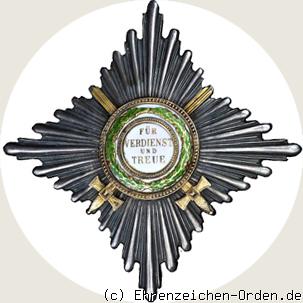 Obverse: Order of Merit Breast star to Comtur Cross with swords
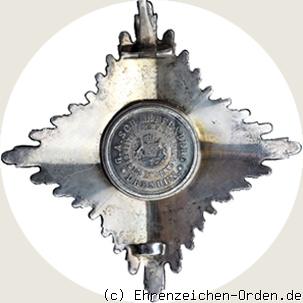 Reverse: breast star of the Order of Merit to the Komtursky Cross with swords
Established:
June 7, 1815 by King Frederick Augustus
October 29, 1866 Sword Foundation
Data:
- Material: silver, silver with gold coating, enamel
- Size: 88mm x 87mm
- Weight: 55.85g
estimated collector price:
Unspecified

 Awards of World War II