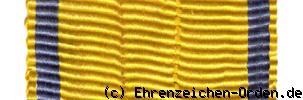
German Awards - Silver Medal "For Courage" 1807
The Medal of Courage was established on March 19, 1807 by Duke Frederick I Augustus of Nassau-Usingen and on August 9, 1807 by Duke Frederick Wilhelm of Nassau-Weilburg by adopting statutes in gold and silver. The medal was supposed to serve as an external sign in order not to let individual feats of military valor be forgotten and give an incentive to descendants. The medal was awarded to Nassau servicemen without a specific rank as a prerequisite for valiant action. Rewarding foreigners was also possible. The award was associated with honorary gold for length of service. Half of the monetary allowance was paid for a silver medal, and all the monetary allowance for a gold medal. Medals were not refundable. It is possible that 1 person received both medals. The Stämpelschneider was Johann Lindenschmitt of Mainz. Medals were awarded in 1807 for the siege of Kohlberg, for the campaigns of 1808-1813 (Austria and Spain) and in 1815 for the battle of Waterloo. The number of awards with a silver medal is 246 pieces. Source: J. Nimmergut, Deutsche Orden und Ehrenzeichen bis 1945, vol. II, 1997.
Round silver medal with a raised narrow border. On top there is a wide eye through which the tape stretches.
Front side:
In the - center is a portrait of the duke with blond hair on his head.
- To the left along the edge is the inscription: - FRIEDERICH - ° - I - ° -.
- On the right along the edge is the inscription: - HERZOG - ZU - NASSAU -.
- Below the edge under the cervical area is small: - LINDENSCHMIT F.
Downside:
- At a distance from the edge is a narrow laurel wreath tied in a loop below.
- In the nested field, 2-line font: - DER -/- BRAUERHEIT. -.
- Crossed behind the lower part of the wreath, arranged obliquely in 3 flags on the left and right.
Tape:
- yellow 36 mm wide, edges 1 mm, side stripes blue 3 mm.
.
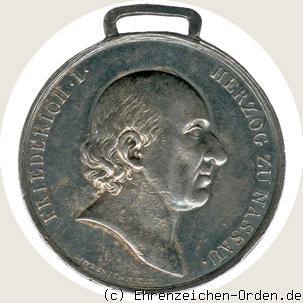 Front side: Silver Medal "For Courage" of 1807
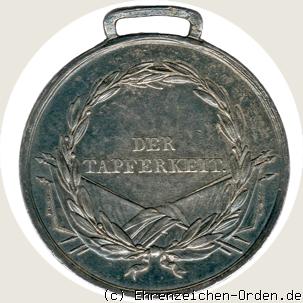 Reverse: Silver Medal "For Courage" 1807
Established:
March 19, 1807 by Duke Frederick I Augustus
Data:
- Material: Silver
- Size: 34mm
- Weight: 14.2g
estimated collector price:
1100 – 1200 €

 Awards of World War II