Awards of Germany - Order of the Black Eagle Small decoration for the order cross
The decoration of the Order of the Black Eagle is made by the highest cabinet order of King William II. established on January 7, 1914. The reason for this was that knights of the order could wear insignia in a reduced form also for a skirt, hunting uniform, or even for mass. There are gold and silver jewelry with gilding.
The Order of the Black Eagle was established on the occasion of the coronation of Frederick I on January 17, 1701.
The slogan of the order: - SUUM CUIQUE - To each his own. The Order of the Black Eagle was not an order of merit, but a knightly order, which was originally awarded only to persons of princely origin and could prove this for generations. With the change of statutes by King Frederick William IV. On February 20, 1848, it was possible to borrow even those who had not previously been a nobleman. They received a hereditary noble title. Prussian princes received the order at birth, but wore it only with the first uniform, after confirmation. The order existed only as a one-class award. Initially, the number of knights was limited to 30. On the day of the coronation, 20 knights were awarded. Until the middle of the XIX century, the stars of the order were embroidered. The first metal stars of the order were made in 1810. Since 1858, stars began to be made only of silver. Few knights of the Order of the Black Eagle were also simultaneously holders of the English Order of the Garter. He could wrap an enameled ribbon around the star. In addition, the stars could be equipped with diamonds. Since 1883, eagles have been enameled between cross sleeves and no longer painted. The decoration of the order also included the collan, an order chain. Initially, each knight received these collans. During the award period, it was later forgotten and again issued to each knight only at the end of the 19th century. The constant wearing of the order was mandatory and for violations was punishable by fines in favor of the orphanage in Königsberg. (abolished in 1847) For 3 minor violations, the order was deprived.
Golden Cross in the form of the Cross of Malta. The cruciform arms are enameled in blue and bordered in gold. Between the cross sleeves, respectively, a black enameled, golden burgundy eagle with a golden crown. Heads of eagles turned up, from bottom to bottom. Bent segment with hole for location of elongated bandage ring is located between tops of upper cruciform arm. The front side with the laid gold medallion. On the ribbon placed on the triangle, there is a silver miniature of the star to the order.
Front side:
- Round gold medallion with smooth raised border.
In - a grainy enclosed field, rough letters - FR -
- On the ribbon is a silver breast star with diamond rays.
- A medallion with a white ring - SUUM CIUQUE - and laurel branches.
- The inner field is yellow enameled with a black eagle.
Downside:
- Without a medallion. Blue enameled cruciform arms reach the middle.
- The eagles between the cruciform arms are also fully expressed and enameled.
Tape:
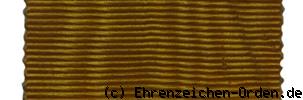
Width 40 mm, golden yellow.
.
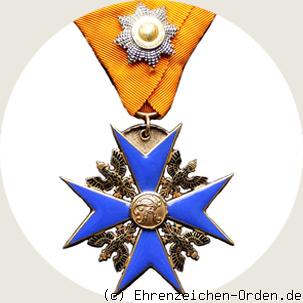 Obverse: Order of the Black Eagle Fine decoration for the order cross
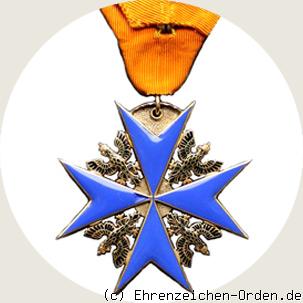 Reverse: Order of the Black Eagle Small decoration for the order cross
Established:
January 17, 1701 by King Frederick I.
January 7, 1914 William II Fine Jewelry Foundation.
Data:
- Material: gold, enamel, silver
- Size: 53mm, star circulation 21mm
- Weight: 31.2g
estimated collector price:
8000 - 8500 € in gold
4000 - 4500 € silver-gilded

 Awards of World War II