German Awards - Order of Pour le Merite for Military Merit
The Order of Pour le Merite was established by Frederick II in 1740 as the successor to the Order of Ordre de la Generosite, established in 1667 by Margrave Frederick. without charters. Until 1810, both civilians and military persons were awarded the order. The order was awarded as an order cross and only 4 times as a large cross. The extensions of the order were the awarding of diamonds (since 1789), oak leaves for exceptional services (since 1813) and the introduction of the crown to the order cross for 50 years of possession (since 1844). In 1866, the Grand Cross with a star was presented and awarded 2 times to Crown Prince Friedrich Wilhelm and Prince Friedrich Karl of Prussia. King William also had a copy. Other carriers of the Grand Cross were Emperor Alexander II. of Russia (1878) and Field Marshal Count von Moltke (1879).
Until 1832, cross hands were enameled in light blue, and the font is written in italics. At the suggestion of the jeweler Hossauer, from this year the font is made in antiquity and gold. The enamel became darker. In 1878, foreigners were forbidden to donate oak leaves. Other distinguishing features of the various award periods are the shape of the eagles and the design of the writing and crown.
Eight-pointed cross made of gold or silver, gilded. The cruciform arms are sheathed in gold and enameled in blue. Between the cross sleeves on the golden Prussian eagle. Heads of eagles are turned higher up, lower down by analogy. Between the tips of the upper cruciform shoulder there is a semicircular segment with a raised border, the inner side is finely cut. It has a hole through which an elongated band ring passes.
Front side:
- On blue enameled cruciform hands made of gold:
- Above: The letter - F - under the Prussian royal crown.
- Left: - Pour -, right: - le Me ', - and bottom: - rite -
Downside:
- Blue enameled cross arms without inscription.
Tape:
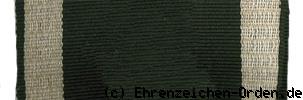
- Tape 1:57 mm wide black, black edges 2 mm, 2 side silver strips of 8 mm.
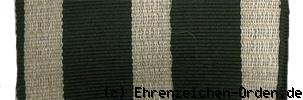
- Tape 2 Multiple rolled products: 57 mm wide black, black edges 2 mm, 2 side stripes and 1 central stripe silver 8 mm each.
Photos taken with www.medalnet.net support
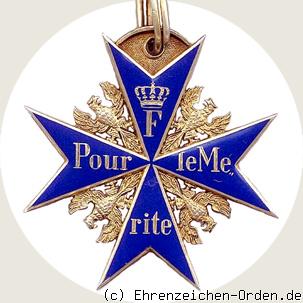 Obverse: Order of Pour le Merite for military merit
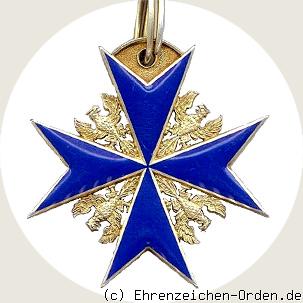 Reverse: Order of Pour le Merite for military merit
Established:
June 1740 by King Frederick II.
Data:
- Material: gold, enamel
- Size: about 53mm
- Weight: about 22g
estimated collector price:
€15,000 - €18,000 in gold
8,000 - 11,000 euros, silver-gilded
OEK Number:
1592/3, 1593/4

 Awards of World War II