German Awards - Order of Merit for Science and Art (Peace Class)
The Pour le Merite peace class was introduced by King Frederick William IV in 1842. Awarded for services to science and art. The order was awarded to persons who, having widely recognized their merits in this area, made an excellent reputation for themselves. Theological sciences were exempted from this. The order continued to be awarded with the revised statutes of 1922 in the Weimar Republic until 1934. In 1952, the order was recreated and continues to exist as a non-state award, but with permission. The number of members of the order is limited to 30 German and 30 foreign members. The order was made of gold. The first production series under the Hossauer manufacturer was slightly smaller (about 54mm x 51.2 mm) and lighter (about 15g), later crosses were in the following sizes and weights. The second producer was Hermann Julius Wilm and his successor. Parts of Hossauer have a 5-leaf bloom above, the later parts of Wilm have a small 5-leaf bloom below.
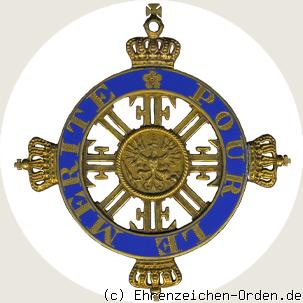
Order of gold in the form of a round openwork medallion. Outside, each 90 ° is offset by 4 gold crowns.
An elongated ribbon ring passes through the imperial apple of the upper crown. (later only one transverse eye)
Front side:
- Outside, a wide gold border hoop enamels the inside in navy.
- It has a golden inscription - POUR - LE - MERITE - a 5-petal flower on top.
- Inside the hoop in gold is a small round medallion with a Prussian eagle.
- The latter is connected to the hoop 4 by 2 opposite letters - F -,
- at the level of the outer crowns. Between 4 Roman numerals 2 - II -.
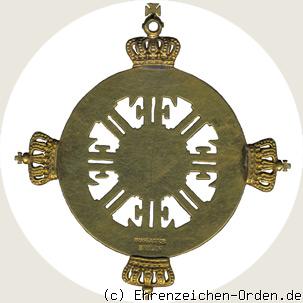
Downside:
- Smooth and golden, without enamel.
- Below is a two-line wreath - HOSSAUER -/- BERLIN -.
Tape:
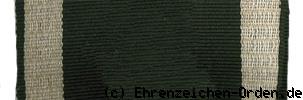
- 57 mm wide in black, black edges 2 mm, 2 side silver strips of 8 mm.
Photos of military antiques Kögl www.mkoegl.de
 Order of Merit for Science and Art (Peace Class
)
 Order of Merit for Science and Art (Peace Class)
Established:
May 31, 1842 by King Frederick William IV.
Data:
- Material: gold, enamel
- Size: about 54.5mm x 57.5mm
- Weight: about 25.5g
estimated collector price:
12,000 - 13,000 € in gold

 Awards of World War II