German Awards - Lippian Rose 2. Class Badge of Honor for Art and Science
This badge of honor was established on June 9, 1898 by Count Regent Ernst von Lippe-Bisterfeld. This award is awarded to people with special merits in the field of science and art. The Badge of Honor was awarded in 3 classes. All other things being equal, in the form of the Lippa rose, the individual classes are distinguished as follows: the 1st class has an open silver crown on top, attached by means of a hinge, a small ring passes through the imperial apple of the crown, and an elongated ribbon ring passes through it. Class 2 has 3-leaf oak foliage suspended in a small ear. The ring of the tape is soldered behind. 3rd grade has on top of crossed petioles a soldered ordinary ear with a ribbon ring. The design of the Lipp rose was made by the sculptor A. Schreitmüller from Dresden. Manufacturers from 1899 to 1914 were the mint of Richard Diller in Dresden and from 1917 the court jeweler K. F. Zimmerman in Pforzheim. Shown here 2. It was awarded only 43 times between 1901 and 1918. Source: Rainer Schwark, order and badge of honor of the principality of Lippe Detmold 1778-1933, works of the Lipp Land Museum, vol. VI, 2005.
Embossed silver badge of honor in the form of a Lippic rose with 5 leaves, one of which is directed upward. Between the rose leaves on a gilded lace leaf. Front and back with a raised, round, gilded central shield in the center of the rose. On the top leaf of the rose there are 2 crossed stems or petioles. In the center, an arched eye soldered on them. 3-leaf oak foliage clung to it. On the back of the oak foliage is a soldered ear with a ribbon ring.
Front side:
- Central shield (21.8 mm) with a wide ring enameled with blue and gold.
- It has a golden inscription: - FOR - ART - AND - SCIENCE - ornament below
. In - the golden field on the left is a man, and on the right is a woman kissing him.
- It should be the consecration of the muse.
Downside:
- The central shield (21.2 mm) is completely gilded with a raised edge.
- On the lower 2/3 along the edge there is an inscription - DONATED - DELIVERED - 9. JUNE - 1898 -.
In the - center is a large letter - E - above it is a crown.
Tape:
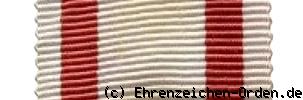
- white 30 mm wide, white edges 4 mm, red side stripes 4 mm.
.
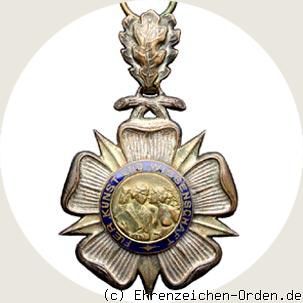 Front: Lippic rose 2. Class Badge of Honor for Art and Science
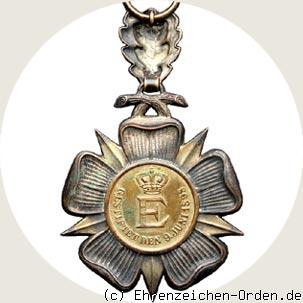 Reverse: Linden Rose 2. Class Badge of Honor for Art and Science
Established:
June 9, 1898 Count Regent Ernst zu Lippe-Bisterfeld
Data:
- Material: silver, partly gilded, enamelled
- Size: 41.3mm x 64.2mm, oak foliage 14mm x 18mm
- Weight: 21g
estimated collector price:
1000 – 1200 €

 Awards of World War II