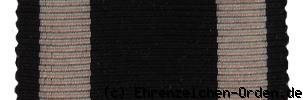
Awards of Germany - Order of the Red Eagle 3rd degree with swords
The Order of the Red Eagle with swords has been awarded since 1854 for military merits. It was founded in 1848 as a result of hostilities. For military merits in peacetime, swords were awarded on a ring crossed over the upper cross sleeve. The order was awarded for military merits on a black and white ribbon. The Order of the Red Eagle of the 3rd class with swords shown here was awarded in the war 1864 32 times, 1866 - 77 times, and in the 1st World War - 72 times. Late crosses after 1916 were made of silver with gilding. Swords are minted in 2 parts, hollow and soldered. All 4 parts are screwed into the medallion cylinder using threaded pins. In the case of fakes and "overrated" pieces, swords are soldered from one piece and or. Sword jewelry is a popular object of manipulation because prices are much higher than jewelry without swords. On June 12, 1792, King Frederick William II. this order as a royal household order. The Royal Order of the Red Eagle originated from the highest Brandenburg Order of the Red Eagle. As changes, he introduced the Prussian royal crown, instead of the princely crown, and the letters F-W-R (Friedrich, Wilhelm, Rex, that is, the king) on the reverse. During the existence of the award, many changes have been made. In 1810, the order was established by King Frederick William III. expanded to the 2nd and 3rd grade and presented oak leaves for the 1st and 2nd grade. The crosses were originally 2nd and 3rd. Same size class. Since 1817, the 3rd class has become smaller, and the existing old crosses as the 2nd. The class is assigned. In 1848, swords were established for military merit. In the period from 1848 to 1854, orders with a purple eagle and a raspberry eagle met in the medallion. Since 1854, the crimson color of the eagle in the medallion has been replaced by scarlet. The extensions for 3rd class were the loop for 3rd class carriers who had previously occupied 4th class or had been 3rd class owners for 10 years. For military merit, swords through the center and swords on the ring. For special merits since 1892 he was awarded the crown. A notable manufacturer of sword ornaments was Johann Wagner & Sohn Berlin. Source: J. Nimmergut, Deutsche Orden und Ehrenzeichen bis 1945, vol. II, 1997.
Hollow made cross made of gold. The cross hand is golden burgundy and enameled. Front and back with enameled round middle shield worn. Through the center are crossed 2 ancient swords with Roman parry wands. On the upper cruciform shoulder is an ordinary ear with a ribbon ring. On the lower cruciform shoulder, the manufacturer's marking is W - for Wagner.
Front side:
- Gold medallion with raised border. In the center on a white background is a red eagle with a hohenzoll chest shield
- On the head is a golden Prussian royal crown, between the catches is a green laurel wreath.
Downside:
- Gold round medallion with raised border. On a white background, rough letters - F - W -.
- Golden Prussian royal crown.
Tape:
- black ribbon 30 mm wide, edges 2 mm, white side strips 5 mm
.
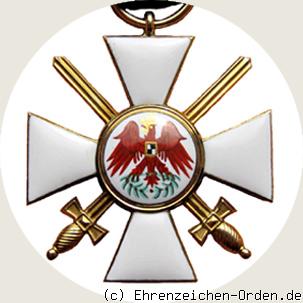 Obverse: Order of the Red Eagle 3rd class with swords
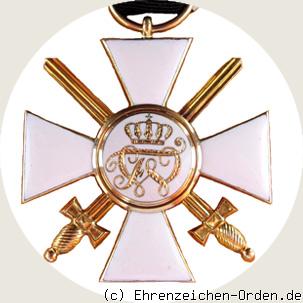 Reverse: Order of the Red Eagle 3rd class with swords
Established:
June 12, 1792 by King Frederick William II.
January 18, 1810 Foundation of the 2nd and 3rd class of King Frederick William III.
September 16, 1848 Fund of swords of King Frederick William IV.
Data:
- Material: gold, enamel
- Size: 38mm, swords 43mm x 2mm
- Weight: 16.2g
estimated collector price:
4700 - 4900 € in gold
4300 - 4500 € silver gilded

 Awards of World War II