German Awards - Order of the Red Eagle - Grand Cross
The Royal Order of the Red Eagle originated from the highest Brandenburg Order of the Red Eagle. On June 12, 1792, King Frederick William II confirmed. (Great) this order as a royal award. As changes, he introduced the Prussian royal crown, instead of the princely crown, and the letters F-W-R (Friedrich, Wilhelm, Rex, that is, the king) on the reverse. During the existence of the award, many changes have been made. In 1810, the order was established by King Frederick William III. expanded to the 2nd and 3rd grade and presented oak leaves for the 1st and 2nd grade. In 1830, the 4th grade was first introduced. Only in 1846 the medallion was enameled in the 4th grade. Since 1854, the crimson color of the eagle in the medallion has been replaced by scarlet. The 4th grade received fine-grained cruciform arms from 1885. Additional extensions of the order were swords for military merit, a loop to the 3rd class, a crown, anniversary numbers, and the upper classes have oak leaves, a crown and a scepter, a bandeau to the order of the crown, a chest star and a large cross with a chain, as well as an Johannite cross. The grand cross and gold chain were presented by William I on 18 October 1861. On October 18, 1864, the John Cross was established for various classes. The following additions were made to the Grand Cross: diamonds, oak foliage, diamonds and oak foliage, swords, oak foliage and swords, swords on the ring, swords and swords on the ring, oak foliage and swords on the ring, diamonds with oak foliage and swords on the ring, henlaub with swords and swords on the ring. In addition, large crosses were awarded with a crown and scepter, as well as with a crown in connection with oak leaves, swords and swords on the ring in variations. Extremely rare variations were so rare that buying or quoting a price is hardly possible. Source: J. Nimmergut, Deutsche Orden und Ehrenzeichen bis 1945, vol. II, 1997.
Golden, eight-pointed cross of the Maltese form. The cruciform arms are enameled in white and sheathed in gold. Between the cross sleeves, respectively, is a golden burgundy, red enameled eagle with a red princely hat on its head. Heads of eagles turned up, from bottom to bottom. Front and back with raised round gold medallion. Bent eye is made between tops of upper cruciform arm to accommodate elongated bandage ring. On the lower cruciform shoulder, the notch mark is W -.
Front side:
- Gold middle medallion with a wide blue enameled border.
- It has a gold font: - SINCERE - ET - CONSTANTER -
In a field - surrounded by gold, winding letters - W R -
Downside:
- The all-gold middle medallion is surrounded by a raised wreath.
- On the left, oak leaves on the right are laurel leaves crosswise tied below.
- In a nested, finely clipped field, the font is 3 lines:
- - DEN -/- 18 OCTBR. -/- 1861 - date of foundation of the Grand Cross.
Tape:
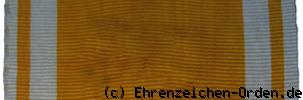
- Strap/shoulder strap 102 mm wide, white edges 6 mm, side stripes yellow-orange 4 mm each, then white 8 mm, central stripes 63 mm yellow-orange.
The pictures show the Grand Cross of the former Reich Chancellor Michaelis.
.
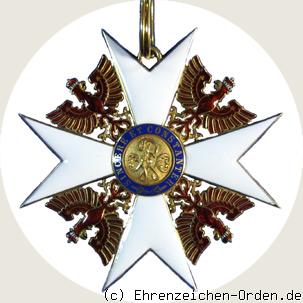 Obverse: Order of the Red Eagle - Grand Cross
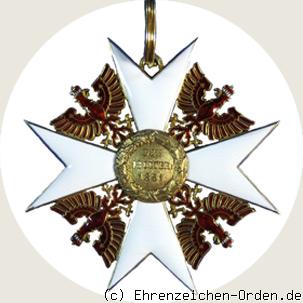 Reverse: Order of the Red Eagle - Grand Cross
Established:
June 12, 1792 by King Frederick William II
October 18, 1861 Grand Cross of King William I.
Data:
- Material: Gold or silver gold-plated/partially enameled
- Size: 80mm
- Weight: about 37g
estimated collector price:
10,000 - 10,300 € in gold
7300 - 7600 € silver-gilded

 Awards of World War II